
(This case is prepared from publicly available information and is intended for the sole purpose of class discussion.)
THE PARADOX
Laura, a marketing student in her senior year, has just received a coveted internship in a top branding agency based in New York City with the hope of a full-time job offer. Sarting from next week, Laura will be working with Kelly, account manager for a top fast fashion company, in a major sustainability branding project.
To Laura, sustainability branding of fast fashion is like solving a paradox. Fast fashion is a recognized source of negative environmental impact. Financial performance requires a top brand to sell more of its fast fashion, creating more polluting junk in the environment. How to solve the obvious contradiction? Is her job merely greenwashing? Is boom of fast fashion inevitably tragedy of the environment?
Laura has every reason to warm up to background information in the highly competitive industry as she will be in the first meeting with Kelly and clients next week.
FAST FASHION IS BOOMING
Fast fashion, known for its quick access to the latest styles at affordable prices to keep customers up with the trendy, has become immensely popular in the past few decades. It includes clothing, footwear, accessories, and others for men, women, unisex, and kids. Major fast fashion brands in the US market are Shein, H&M, Zara, Fashion Nova, Forever21, Mango, and more.
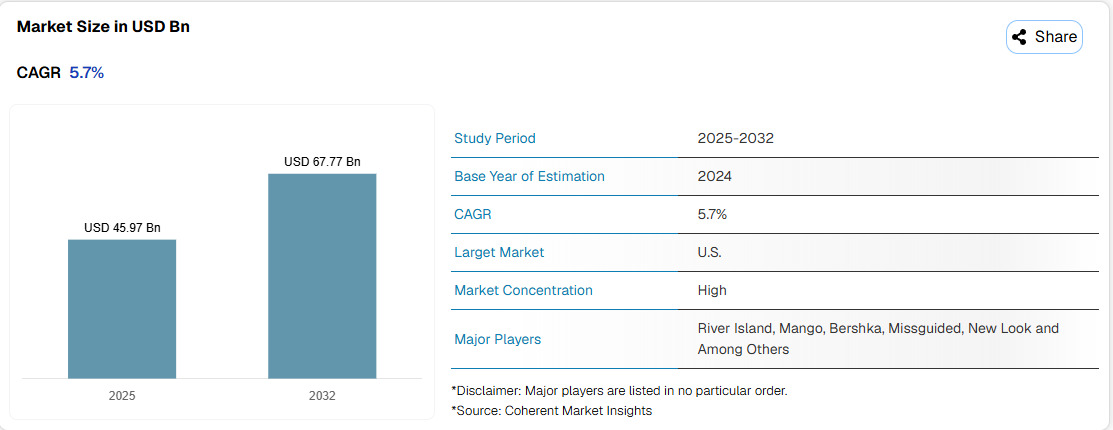
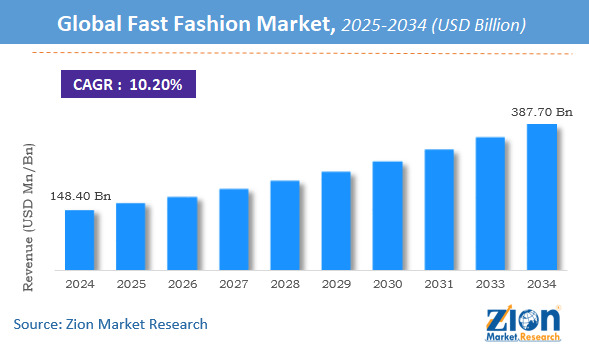
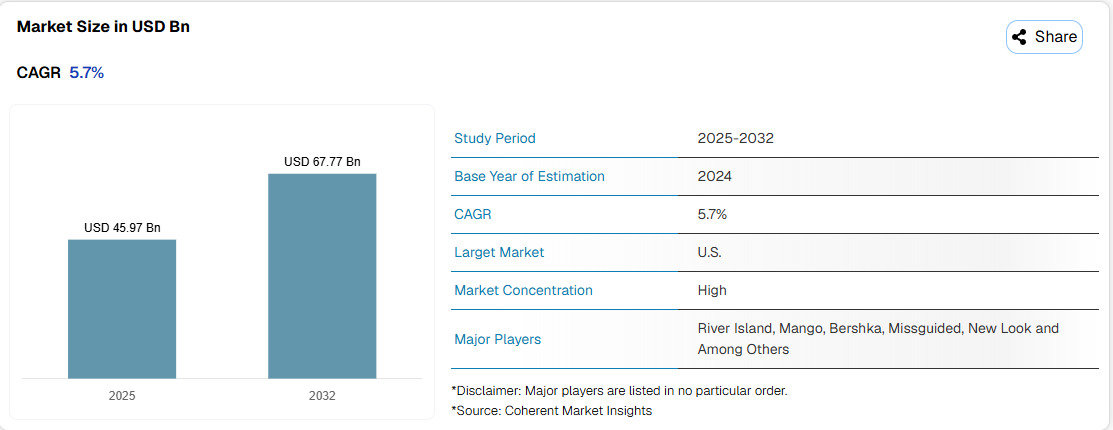
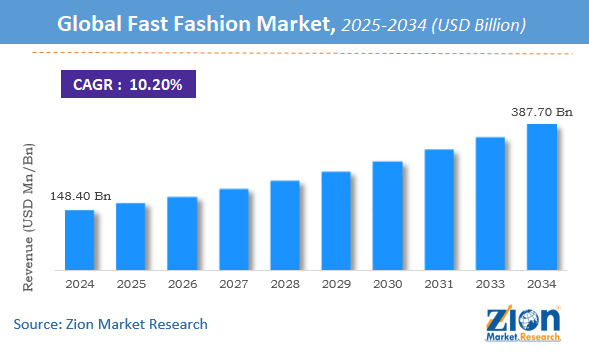
CoherentMI, a leading global market intelligence company, estimates that the fast fashion market in the US alone was $45.97 billion in 2025, is expected to reach US$ 67.77 billion by 2032, and will grow at a compound annual growth rate (CAGR) of 5.7% from 2025 to 2032 (see Figure 1) thanks to popularity of social media, celebrity influence, online shopping, growing youth population and the desire to keep up with latest fast fashion trends[1]. Globally, this market was estimated to be $148.40 billion in 2024 and is predicted to grow to $387.70 billion by 2034 with a CAGR of 10.20% between 2024 and 2034 (see Figure 2)[2].
ENVIROMENTAL IMPACT
The popularity of fast fashion has a negative environmental impact.
It used to be that fashion was purchased to last longer, with fashion companies launching two seasons only in a year: Fall/Winter and Spring/Summer. As trend cycles sped up in the 1990s, leading brands such as Forever21 and Zara pioneered with as many as 52 “micro-seasons” per year. Today, brands such as Shein and Temu use sophisticated algorithms to get new styles to market in a matter of days[3]. Consequently, clothes are often purchased to be worn only a few times before being discarded. This throwaway culture results in large amounts of textile waste ending up in landfills.
Fast fashion is mostly made with low-cost, synthetic fibers like polyester, nylon and acrylic because they have many preferable consumer benefits (e.g., lightweight, water resistant, less likely to wrinkle or stain). However, synthetic fibers are based on fossil fuels and are difficult to biodegrade. It takes 3,781 liters of water to make a pair of jeans, from the production of the cotton to the delivery of the final product to the store. That equates to the emission of around 33.4 kilograms of carbon equivalent[4]. The United Nations Environment Programme (UNEP) estimated that the global apparel and footwear industries account for an estimated 2 to 8 per cent of the world’s greenhouse gas emissions[5].
Environmental pollution also comes from dyeing and treatment of textiles which often involve the use of toxic chemicals. The fast fashion industry predominantly outsources its production to countries where standards for environmental protection are low and factories can get away with discharging untreated pollutants, leading to serious environmental and health issues for their communities. Workers also earn much lower wages in these countries and working conditions grim or even inhumane by Western standards. Fast fashion business executives clearly know that customers will most likely be attracted by low price tags but ignore country-of-origin tags (e.g., “Made in Bangladesh”).
ATTITUDE-BEHAVIOR GAP
Customers, particularly younger customers like Millennials (born between 1981 and 1996) and Gen-Z’s (born between 1997 and 2012), are more concerned with environmental preservation and labor protection, and hold more supportive attitudes toward sustainability. Market research by consulting firm Simon-Kucher & Partners in 2022 found that 54% of Gen Z (ages 18-24) and 57% of millennials (ages 25-39) said sustainability is important to them[6]. However, the two age groups, including college students, are also the leading consumers of fast fashion. In a 2022 market research report, 72% of college students said they have shopped fast fashion in the past year[7]. In a Fashion Drive report[8], Professor Green of Cornell University in Ithica, NY, made these remarks: “Gen Z — they say, study after study, survey after survey, more than any other generation — they’re saying they want sustainable fashion, and more than any other generation they are the biggest segment of the population buying fast fashion.”
Why the gap? An English scholar’s observation may provide an interesting perspective.
THE TRAGEDY OF THE COMMONS
England. About two hundred years ago. Oxford University Professor William Forster Lloyd observed a sharp contrast between common pastures (i.e., not privately owned) and privately owned pastures. Common pastures that could be used by all herdsmen were devastated due to overgrazing and lack of maintenance. In contrast, adjoining private pastures were lush because they were carefully maintained and protected with fences.
This phenomenon was referred to as “the tragedy of the commons” by Professor Hardin in his widely cited article that appeared in Science in 1968. His explanations: 1) Humans are guided by self-interest[9]; and 2) natural resources are limited.
Pastures are natural resources with a limited carrying capacity. If you do not overgraze, your cattle farm will permanently benefit from their grass. However, if you overgraze and never let them rest, the pastures will be ruined, and you will not be able to graze your cattle any longer.
English herdsmen should presumably know that simple truth and be smart enough to keep the common pastures in good shape for their own longer-term benefit. Things turned out to be just the opposite, for two reasons: 1) To earn a living, each herdsman had to do what benefited himself now (in economics, “self-interested”); and 2) Each herdsman did not know the limits of the carrying capacity; nor did he bother himself to find out because these pastures were not his private property – common pastures were for all herdsmen to use but for no one to own.
THE TRAGEDY OF THE ENVIROMENT?
The tragedy of the commons is not just about pastures in England two hundred years ago – it can be applied to most, if not all, publicly shared resources in the world today. The earth is the natural environment of all humanity. This natural environment has a limited carrying capacity for waste disposal and chemical pollution. On the other hand, the earth belongs to everyone (collectively, every country of the world) who lives on this planet but is owned by no one (collectively, any one country of the world). Human minds are guided by self-interest, motivated to seek immediate personal gains rather than to protect the sustainability of shared resources for the future good. With no adequate limits imposed, use of shared resources will eventually result in overuse, abuse, and devastation.
To put it in the context of fast fashion purchases, consumers tend to prioritize immediate personal benefits (e.g., product features, affordability, convenience), and care less about longer-term environmental harms. It is no secret that the boom of the fast fashion industry has benefited from the converging trends of social media, influencers, price hunting, and online shopping, all working together to deliver immediate satisfaction. Indeed, Millennials and Gen-Z consumers in the US talk the talk of sustainability but do not walk the walk when it comes to their consumption of fast fashion. That said, it is only fair to point out that fast fashion is purchased by customers in all age groups, in the US and globally. The difference: in other age groups and in other countries, there is less of a gap between vocal support for sustainability and actual purchase of fast fashion. Consumers, in other American age groups or in other countries, may also be guilty of overconsumption in fast fashion and they, regrettably, are not as supportive to sustainability in their attitudes as Millennial and Gen-Z American consumers[10].
The predicted fast fashion boom will not endure without widespread consumer support (with purchases) from customers of fast fashion. As mentioned earlier, market research companies have predicted that the fast fashion boom will continue. Will customers volunteer to cut back on fast fashion purchases to save the planet from being rendered into a huge dumping ground? Will business executives cut back on selling fast fashion when customers are still buying? What if answers to the questions are all negative? Can the world avoid the environmental tragedy?
WHAT CAN BE DONE TO AVOID THE TRAGEDY
Fortunately, the tragedy has not materialized yet. Laura appreciates her position even more for challenging her to proposing sustainable marketing programs that will make a meaningful difference at the top fast fashion brand. Now, Laura hopes to combine her learning from the tragedy of the commons with marketing and consumer behavior before thinking about specifics by addressing the following questions:
Q1. The tragedy of the commons hinted at different directions of reasoning in finding an ownership-based solution: capitalism or socialism. The capitalistic reasoning is to privatize common pastures, leveraging the power of private ownership to rescue pastures from being ruined. The socialist reasoning is to create a management authority that imposes limits, as some common pastures of old England were protected by the tradition of stinting[11] (i.e., limiting each herdsman to a fixed number of animals). Now, apply these directions of reasoning to solve a potential environmental tragedy (fast fashion overconsumption leading to destructively excessive waste disposal and chemical pollution). Propose one solution in each direction and compare their advantages and disadvantages.
Q2. The commercial success of fast fashion has a lot to do with its low prices achieved by using low-cost synthetic fibers that are difficult to biodegrade and outsourcing production to countries where environmental standards and labor costs are low. On the other hand, business executives are increasingly urged to adopt a sustainable, triple bottom-line approach to marketing, considering not only financial returns but also environmental and social impact. In the real world of business, however, higher environmental and social standards may decrease financial returns. What would your team do if placed in a managerial position of a fast fashion company? Explain why in connection with your discussion in Q1.
Q3. Discuss what benefits consumers prioritize in shopping of high fashion vs fast fashion: 1) compile a list of major consumer benefits in fashion shopping and put them into the diagram below; 2) compare priorities in choosing consumer benefits between high fashion and fast fashion; 3) discuss the importance of sustainability benefits in consumer fashion shopping; and 4) explain fast fashion shopping behavior from the perspective of the tragedy of the commons.
Q4. Why is fast fashion so popular among younger consumers? Explore the attitude-behavior gap among Millennial and Gen Z consumers, who say they want sustainable fashion but are the largest customer segment buying fast fashion. Fast fashion purchase does not appear to be driven purely by financial constraints because higher household income (>$70,000) consumers generate on average 76% more clothing waste than consumers with lower incomes, and richer countries produce 95.7 pounds of textile waste per person each year while poorer countries produce 54.7 pounds per person annually[12]. Create a social marketing program to engage Millennial and Gen-Z consumers, bridge the attitude-behavior gap, and affect actual changes in purchase and consumption. The program is expected to impress a top company selling fast fashion but also hoping to brand itself on sustainability leadership.
Teaching Note
BOOM OF FAST FASHION, TRAGEDY OF THE ENVIRONMENT?
SYNOPSIS
The fast fashion industry is booming and will continue to boom in the next decade. However, the industry boom fuels a throwaway consumer culture that has negative environmental impacts. Why do Millennial and Gen Z consumers say they want sustainable fashion while being the biggest buyer of environmentally unsustainable fast fashion? The tragedy of the commons was introduced to cast insights into this attitude-behavior gap. Students are then challenged to comprehend the underlying mechanisms described in the tragedy of the commons in connection with consumer behavior and to apply the learning in developing meaningful action plans as solutions to the challenges.
LEARNING OBJECTIVES
This case is designed to help students achieve the following learning objectives:
-
Apply learning from the tragedy of the commons and from consumer behavior to conducting meaningful discussion of private-ownership vs management-authority approaches to solving a potential environmental tragedy from fast fashion overconsumption.
-
Develop and defend an action plan adopting a triple bottom-line approach to managing fast fashion businesses.
-
Comprehend the distinction between immediate benefits and long-term benefits in shopping and consumption and explain why consumers prioritize immediate benefits over long-term benefits from the perspective of the tragedy of the commons.
-
Explore the attitude-behavior gap among Millennial and Gen-Z consumers and develop a social marketing program to engage and affect actual changes in their consumption behavior.
A note about PRIME’s Impactful Five (i5) characteristics: This case actively engages students in learning to rise up to real sustainability challenges in a meaningful manner through an iterative process of connecting their own consumption behaviors with economic behavior observed two hundred years ago.
POSITION IN COURSE
This case can be used at undergraduate and graduate levels in business courses covering relevant topics in consumer behavior, marketing, management, entrepreneurship, sustainability, and business ethics.
RELEVANT READINGS
Peck, Kirk, Luangrath, and Shu, Caring for the Commons: Using Psychological Ownership to Enhance Stewardship Behavior for Public Goods: Of the Journal of Marketing Vol 85, No. 2 (2021): Pages 33-49.
Shultz and Holbrook, Marketing and the Tragedy of the Commons: A Synthesis, Commentary, and Analysis for Action: Of the Journal of Public Policy & Marketing Vol 18, No. 2 (1999): Pages 218-229.
Van Vugt, Averting the Tragedy of the Commons: Of the Current Directions in Psychological Science Vol 18, No. 3 (2009): Pages 169-173.
Brooke Roberts-Islam, “Next-Gen ‘Bio-Based’ Synthetics Are Here, But When Will They Replace Polluting Polyester?” Forbes, Mar 11, 2022, accessed June 6, 2026, https://www.forbes.com/sites/brookerobertsislam/2022/03/11/next-gen-bio-based-synthetics-are-here-but-when-will-they-replace-polluting-polyester/.
Garrett Hardin, “Tragedy of the Commons,” Econlib, accessed June 6, 2026, https://www.econlib.org/library/Enc/TragedyoftheCommons.html.
Sustainable Brands, “Textile Additive Expedites Breakdown of Stubborn, Synthetic Fibers,” accessed June 6, 2026, https://sustainablebrands.com/read/chemistry-materials-packaging/textile-additive-expedites-breakdown-synthetic-fibers.
TEACHING PLAN
-
The case can be used in seated classroom discussion as described below. For online courses, questions can be assigned as topics in an online discussion forum.
-
The case can also be assigned as a project at the end of a semester, with two topic options (Topic Option 1: Q1 and Q2; Topic Option 2: Q3 and Q4).
ASSIGNMENT QUESTIONS
Q1. The tragedy of the commons hinted at different directions of reasoning in finding an ownership-based solution: capitalism and socialism. The capitalistic reasoning is to privatize common pastures, leveraging the power of private ownership to rescue pastures from being ruined. The socialist reasoning is to create a management authority that imposes limits, as some common pastures of old England were protected by the tradition of stinting (i.e., limiting each herdsman to a fixed number of animals). Now, apply these directions of reasoning to solve a potential environmental tragedy (fast fashion overconsumption leading to destructively excessive waste disposal and chemical pollution). Propose one solution in each direction and compare their advantages and disadvantages.
Q2. The commercial success of fast fashion has a lot to do with its low prices achieved by using low-cost synthetic fibers that are difficult to biodegrade and outsourcing production to countries where environmental standards and labor costs are low. On the other hand, business executives are increasingly urged to adopt a sustainable, triple bottom-line approach to marketing, considering not only financial returns but also environmental and social impact. In the real world of business, however, higher environmental and social standards may decrease financial returns. What would your team do if placed in a managerial position of a fast fashion company? Explain why in connection with your discussion in Q1.
Q3. Discuss what benefits consumers prioritize in shopping of high fashion vs fast fashion: 1) compile a list of major consumer benefits in fashion shopping and put them into the diagram below; 2) compare priorities in choosing consumer benefits between high fashion and fast fashion; 3) discuss the importance of sustainability benefits in consumer fashion shopping; and 4) explain fast fashion shopping behavior from the perspective of the tragedy of the commons.
Q4. Why is fast fashion so popular among younger consumers? Explore the attitude-behavior gap among Millennial and Gen Z consumers, who say they want sustainable fashion but are the largest customer segment buying fast fashion. Fast fashion purchase does not appear to be driven purely by financial constraints because higher household income (>$70,000) consumers generate on average 76% more clothing waste than consumers with lower incomes, and richer countries produce 95.7 pounds of textile waste per person each year while poorer countries produce 54.7 pounds per person annually. Create a social marketing program to engage Millennial and Gen-Z consumers, bridge the attitude-behavior gap, and affect actual changes in purchase and consumption. The program is expected to impress a top company selling fast fashion but also hoping to brand itself on sustainability leadership.
ANALYSIS
Q1. The tragedy of the commons hinted at two different directions of reasoning in finding an ownership-based solution: capitalism and socialism. The capitalistic reasoning is to privatize common pastures, leveraging the power of private ownership to rescue pastures from being ruined. The socialist reasoning is to create a management authority that imposes limits, as some common pastures of old England were protected by the tradition of stinting (i.e., limiting each herdsman to a fixed number of animals). Now, apply these directions of reasoning to solve the potential environmental tragedy (fast fashion overconsumption leading to destructively excessive waste disposal and chemical pollution). Propose one solution in each direction and compare their advantages and disadvantages.
This question may be used to develop critical reasoning skills of students.
Students may need help to better understand the tragedy of commons. Instructor may use the following illustration to help:
Let us illustrate with an example. Suppose Herdsman A kept 20 cattle initially and increased to 30. He did not know if his action of adding 10 cattle would break the pasture’s carrying capacity; nor did he bother himself to find out. He was more focused on his personal gain (50% increase in income). What would other herdsmen do in response? If Herdsman B also kept 20 cattle, would he volunteer to decrease by 10 cattle to avoid overgrazing? Probably not, because he would lose his income by 50%. Would he worry about pastures being overgrazed? He did not know, nor did he bother himself to find out how close they were to the capacity limits of the pastures. Herdsman B therefore would increase his cattle to 30 to match the competition. In a similar fashion, Herdsmen C, D and, eventually, all herdsmen would increase their cattle. What about the common pastures? Well, they were common (for public use), owned by no one, and protected by none – unlike privately owned pastures. One by one, all common pastures would be ruined. End results? No one herdsman could benefit from common pastures any longer because they had been rendered into barren and desolate lands.
Students may also come up with different answers. Merits may be assessed by 1) correct understanding of the tragedy of the commons; and 2) logical clarity and consistency of the argument. The following information is best used as a point of reference.
As illustrated in the tragedy of the commons, privately owned pastures are properly maintained and protected. In line with this capitalistic reasoning, private lands and waters should presumably be protected by owners (e.g., individuals or business entities) as their private property. For example, homeowners will protect their own homes and neighborhoods from being turned into dumping grounds. However, a strictly privatized approach – through property ownership of private entities – may apply to only a fraction of the planet’s lands and waters, leaving out most of the earth’s surface. Most lands and waters may be difficult or impossible to privatize because they are 1) owned and managed by local, state, or national governments in over two hundred countries of the world; or 2) owned and managed by no one – neither private entities nor governments – but shared by all humanity (e.g., international waters and lands such as the high seas and Antarctica).
Let us discuss government ownership and management first. In old England, some common pastures were protected from ruin by limiting each herdsman to a fixed number of cattle, a practice referred to as “managed commons” which essentially was a socialist approach[13]. However, protection quality varied depending on management quality. When it comes to fast fashion waste disposal and chemical pollution, governments may impose restrictions by passing and enforcing laws to protect lands and waters under their jurisdiction. But the reality in this world is that environmental protection standards vary greatly across countries. Furthermore, management quality can be complicated by government inefficiency and corruption. Therefore, countries with low environmental standards, plus bureaucratic and corrupt governments, are more likely to have their lands and waters seriously polluted first.
Second, lands and waters shared by all countries of the world are impossible to privatize (a capitalistic approach) or subject to the jurisdiction of any one government (a socialist approach). These would include Antarctica and international waters, the protection of which is subject to treaties among countries of the world. However, their protection may be complicated by the international nature of jurisdiction - who is to enforce international treaties when violations occur by non-country individuals and entities (e.g., waste dumping by container ships or cruise ships on international waters). It also depends on whether, and to which extent, international law is enforced when broken by country actors, e.g., when countries discharge wastes and chemical pollutants into oceans, breaking their treaty obligations, or being non-members and having no obligations to the international treaty in the first place.
In a mixed approach combining capitalistic and socialist reasonings, a system (socialist) may be created in which fast fashion consumers and businesses are given ownership of their environmental impact – incentives to minimize waste and pollution (capitalistic). In the US, for example, governments may use a system of “quotas” and “credits” to manage industrial pollution. Companies are allotted pollution “quotas” that can be sold and purchased in the marketplace. If you pollute less than your quota, your unused quota are “credits” that can be sold for cash. On the other hand, if you pollute more than your quota, you will have to pay cash to buy quota in the marketplace to discharge your pollutants. Companies are thus financially incentivized to excel in environmental protection (Van Vugt 2009). Another example, governments and companies may work together to create incentives for recycling programs, in which consumers bring back their unused fashion to receive store credits.
Q2. The commercial success of fast fashion has a lot to do with its low prices achieved by using low-cost synthetic fibers that are difficult to biodegrade and outsourcing production to countries where environmental standards and labor costs are low. On the other hand, business executives are increasingly urged to adopt a sustainable, triple bottom-line approach to marketing, considering not only financial returns but also environmental and social impact. In the real world of business, however, higher environmental and social standards may decrease financial returns. What would your team do if placed in a managerial position of a fast fashion company? Explain why in connection with your discussion in Q1.
This question may be used to develop critical reasoning skills of students.
Students may likely come up with various answers. Students are expected to go beyond the naïve acceptance of the triple-bottom line approach, by demonstrating their understanding of the difficulty of meeting the three goals at the same time. Merits may be assessed by logical clarity and consistency of the argument. Some examples for further discussion are included below:
Participate in market-based environmental programs. Self-interested consumers and business executives seek rewards and avoid punishments. In the US, for example, governments use a system of “credits” to manage industrial pollution. Companies will be penalized if they pollute the environment beyond their allotted credits. Companies that excel in environmental protection may sell their credits to other companies needing the credits to avoid penalty (Van Vugt 2009). However, the credits system applies only to US-based manufacturers, not to sellers of fast fashion who import from other countries with no such systems where environmental preservation standards are much lower.
Build brand image on sustainability leadership. Companies and their customers may do their part in counteracting the environmental impacts of fast fashion. For example, brands may be exploring more sustainable practices (e.g., using eco-friendly materials, improving waste management, and ensuring fair labor practices), launch integrated marketing communication campaigns to involve customers to increase awareness of, identification with, and trust of their environmental advocacy and leadership (Peck, Kirk, Luangrath, and Shu 2021; Shultz and Holbrook 1999; Van Vugt 2009).
Do business as usual and wait for the problem to go away. Scenarios can include:
-
Fast fashion may decline because cultural tides come and go. Millennials and Gen-Z consumers will, hopefully, grow out of their fast fashion tastes as they become more established financially and develop more sophisticated consumption styles.
-
Governments will act. More governments in the world will eventually act, making it illegal to let environmental pollution get out of control. Businesses just need to obey the law, not to go above or below.
-
Technology innovations. Researchers and entrepreneurs are tirelessly working to find technology-based solutions without requiring changes in consumer behavior. For example, adding certain chemical agents to synthetic fibers may expedite their biodegradation[14]. Also, in the search for alternatives to synthetic fibers, bio-based synthetics that biodegrade naturally may be considered a promising replacement option[15]. However, effectiveness is still being experimented and industrial adoption is likely to be anything but certain.
Q3. Discuss what benefits consumers prioritize in shopping of high fashion vs fast fashion: 1) compile a list of major consumer benefits in fashion shopping and put them into the diagram below; 2) compare priorities in choosing consumer benefits between high fashion and fast fashion; 3) discuss the importance of sustainability benefits in consumer fashion shopping; and 4) explain fast fashion shopping behavior from the perspective of the tragedy of the commons.
- By reflecting on the case material, personal experiences and observations, students should have no difficulty generating a list of major consumer benefits in fashion shopping and putting them into the diagram. Students are expected to be clear and consistent in their logic of compiling the list and putting benefits into the diagram. The following is for demo purposes.
-
Students should be able to quickly find out that priorities are given to immediate benefits of price, product and shopping in fast fashion shopping unlike in high fashion shopping.
-
Students should be able to quickly point out that sustainability benefits often take a back seat in consumer fast fashion shopping.
-
The reason why immediate benefits are prioritized while sustainability benefits are given a back seat is because self-interest, according to the tragedy of the commons, is human nature that motivates consumers to seek immediate personal gains such as low price, product styles, and shopping convenience, rather than future shared benefits of sustainability.
Q4. Why is fast fashion so popular among younger consumers? Explore the attitude-behavior gap among Millennial and Gen Z consumers, who say they want sustainable fashion but are the largest customer segment buying fast fashion. Fast fashion purchase does not appear to be driven purely by financial constraints because higher household income (>$70,000) consumers generate on average 76% more clothing waste than consumers with lower incomes, and richer countries produce 95.7 pounds of textile waste per person each year while poorer countries produce 54.7 pounds per person annually. Create a social marketing program to engage Millennial and Gen-Z consumers, bridge the attitude-behavior gap, and affect actual changes in purchase and consumption. The program is expected to impress a top company selling fast fashion but also hoping to brand itself on sustainability leadership.
Explore the attitude-behavior gap among Millennial and Gen Z consumers
While it may be tempting to think that fast fashion purchase should be driven purely by financial constraints (e.g., of public university students), there is reason to examine the consumption culture of the Millennial and Gen-Z age cohorts driven by human nature despite sustainability push in school education. First is strong influence from social media that makes consumers covet trendy fashion styles. Instagram and TikTok, for example, are two major social media apps used by Gen-Z customers, to which many get addicted thanks to their recommendation algorithms that can quickly figure out what you want to see. The more you use social media, the more likely influencers will be able to pitch some trendy pieces that speak to your heart. Then come irresistibly low-price appeals like “get this for just $20” or “get that for only 15 bucks”, especially so in the ads by Shein and Temu. Third is the convenience of online shopping so you can indulge yourself right then and there by placing your order from the social media app on your smart phone.
According to the tragedy of the commons, 1) humans (customers and business executives) are guided by self-interest; and 2) natural resources have a limited capacity (the carrying capacity of our planet for waste disposal and pollution) in most circumstances.
Low prices are much more important to self-interested customers and business executives. Fast fashion is extremely accessible for its incredibly low prices because costs associated with the environment (and labor conditions) are not included in the price tags. Environmental protection is the joint responsibility of all humanity. However, like common pastures, this responsibility is not clearly assigned to anyone. Out of self-interest, customers are likely to care much more about getting a good deal than about the environment. Likewise, business executives under the pressure of sales performance are keenly aware of this consumer psychology. This is especially true when environmental costs are “externalized” to countries of manufacturing, physically and psychologically distant from the consumer’s local community.
Negative impacts on environmental sustainability are also more difficult to understand than low prices. Environmental impacts are often complex for the average consumer to comprehend. For example, the average consumer may have difficulty understanding what it means that the fashion industry is responsible for 10% of annual global carbon emissions, more than all international flights and maritime shipping combined. Many more industries than fast fashion rely on fossil fuel chemicals: plastics, fertilizers, cosmetics, drugs, just to name a few. Landfills have many more different sources than fast fashion. Will the consumer attend to this alarm?
Self-interested customers and business executives will ignore inconvenient evidence. In addition to the average consumer’s difficulty of comprehending environmental and labor impacts. The comprehension difficulty will be further complicated by motivated reasoning. Should consumers take responsibility for buying a few pieces of fast fashion? Celebrities flying private jets produce much more carbon emission. Should developing countries take responsibility for needing cheaper clothing desperately? Developed countries have industries that produce much more waste.
Even though some consumers may be willing to pay more for fashion deemed more sustainable, the dominant majority will likely find the low-price appeals of fast fashion too hard to resist. Will the boom of fast fashion push the public interest of sustainability one step closer to environmental ruin, as predicted in the tragedy of the commons? There is reason to worry about it – unless meaningful actions are taken.
Create a social marketing program to engage Millennial and Gen-Z consumers
While there is no one “correct” design of a social marketing program to Millennial and Gen-Z age cohorts, a good design is expected to be characterized by 1) solid understanding of their consumer behavior (e.g., social media use and influence, FOMO or fear of missing out, diversity in self-expression, more vocal support for sustainability); 2) creative content to engage (e.g., content featuring transparency and authenticity of the program); and 3) actionable program elements to affect behavior changes (e.g., recycling for store credits).
For demo social marketing programs, refer to:
H&M’s repairing and recycling program. Information is available from: https://www2.hm.com/en_us/sustainability-at-hm/our-work/close-the-loop.html
Zara’s repair, resale, and donation services. Information is available from:
“U.S. Fast Fashion Market Size and Share Analysis – Growth Trends and Forecasts (2025 - 2032),” CoherentMI, accessed June 6, 2026, https://www.coherentmi.com/industry-reports/us-fast-fashion-market.
“Fast Fashion Industry Prospective,” Zion Market Research, accessed June 6, 2026, https://www.zionmarketresearch.com/report/fast-fashion-market.
Alyssa Hardy, “Everything You Need to Know About Fast Fashion,” Vogue, April 24, 2024, https://www.vogue.com/article/what-is-fast-fashion, accessed June 6, 2026.
“How Much Do Our Wardrobes Cost to the Environment?” World Bank Group, accessed June 6, 2026, https://www.worldbank.org/en/news/feature/2019/09/23/costo-moda-medio-ambiente.
“Cleaning Up Couture: What’s in Your Jeans?” UN Environment Programme, accessed June 6, 2026, https://www.unep.org/news-and-stories/story/cleaning-couture-whats-your-jeans.
“The intention gap: when buying and beliefs don’t match,” Fashion Dive, accessed June 6, 2026, https://www.fashiondive.com/news/sustainable-fashion-consumer-demographics-gen-z/650864/.
“The intention gap: when buying and beliefs don’t match.”
“The intention gap: when buying and beliefs don’t match.”
Note that “self-interest” in economics is a neutral terminology. It is not equal to the negative judgment of “selfishness” – being immoral, unethical, or illegal in pursuing self-interest.
“The intention gap: when buying and beliefs don’t match.”
Garrett Hardin, “Tragedy of the Commons,” Econlib, accessed June 6, 2026, https://www.econlib.org/library/Enc/TragedyoftheCommons.html.
“Fast Fashion Statistics (2025),” Uniform Market, accessed June 6, 2026, https://www.uniformmarket.com/statistics/fast-fashion-statistics
Garrett Hardin, “Tragedy of the Commons,” Econlib, accessed June 6, 2026, https://www.econlib.org/library/Enc/TragedyoftheCommons.html.
“Textile Additive Expedites Breakdown of Stubborn, Synthetic Fibers,” Sustainable Brands, accessed June 6, 2026, https://sustainablebrands.com/read/chemistry-materials-packaging/textile-additive-expedites-breakdown-synthetic-fibers.
Brooke Roberts-Islam, “Next-Gen ‘Bio-Based’ Synthetics Are Here, But When Will They Replace Polluting Polyester?” Forbes, Mar 11, 2022, accessed June 6, 2026, https://www.forbes.com/sites/brookerobertsislam/2022/03/11/next-gen-bio-based-synthetics-are-here-but-when-will-they-replace-polluting-polyester/.