
Introduction
AI’s ubiquity and exponential growth, particularly in the field of marketing, are fast evolving: from automated personalization, creative design, and customer-journey mapping to data-driven performance tracking.
In marketing, GenAI is inevitable. All ads will be created by machines. All ads will be placed by machines. All ads will be seen by machines. What are we doing to get ready? All the players including Marketing Professionals, Professors, and Students need to have clearly defined expectations and roles related to GenAI sooner rather than later, so that we can tackle this together. (Greg Stuart, CEO of MMA Global)
Building on research emphasizing the need for classrooms to adapt to evolving industry standards (Reavey et al., 2021), this study introduces the organizational behavior concept of Role Conflict into the marketing classroom to deepen the understanding of student and instructor experiences. Adopting new technologies remains a central priority in marketing education (Crittenden et al., 2019), with generative AI emerging as one of the most recent tools influencing the field. Students’ GenAI use is shaped by motivation and self-esteem, as well as concerns about automation (Pavone, 2025).
AI tools such as ChatGPT remain imperfect but increasingly influential in marketing practice (Guha et al., 2024). MMA Global and its Marketing Organization Strategy Think Tank (MOSTT) work with academia to address concerns in the changing market. For example, MMA Global has collaborated with researchers on work examining the organizational capabilities needed to improve marketing effectiveness (Rodríguez-Vilá et al., 2020) and the organizational changes needed to address AI-mediated consumer search (Pettiette & Whitler, 2026). The think tank research collected by MMA Global (Rodríguez-Vilá et al., 2025; Rodríguez-Vilá & Bharadwaj, 2024) addresses the needs of the marketing industry in terms of AI. These industry findings indicate that professional norms around AI usage may differ sharply from the academic environments in which students are trained, reinforcing the cross-contextual nature of Role Conflict this study examines.
The MMA Global dataset (N = 521) offers useful comparative insight, with more than 80% of respondents in managerial roles across financial services, retail, and technology sectors. The MMA industry survey identified task efficiency and cost reduction as the most common AI applications. Table 1 provides examples from an MMA white paper and data analyses illustrating how organizations are leveraging AI to achieve these outcomes (Rodríguez-Vilá et al., 2025; Rodríguez-Vilá & Bharadwaj, 2024). Taken together, these practitioner data suggest that GenAI is being applied across a wide range of marketing tasks, rather than within a single clearly bounded use case. This range of applications raised a related educational question for our study: whether students are being given sufficiently clear and consistent expectations for how AI should be used across classroom and workplace contexts.
According to the MMA dataset, approximately one out of every ten businesses collaborated with university students on projects integrating AI into the classroom. This is important because faculty and students are applying these skills in the classroom and learning to use the tools expected in industry. Table 2 provides insight into how industry leaders see the biggest differences when utilizing AI in the workplace.
The technology is transforming industry processes and prompting educators to reconsider how marketing curricula prepare students for AI-driven contexts. Recent analyses characterize this as a technology-augmented era reshaping both marketing and marketing education (Grewal et al., 2025; Pettiette et al., 2026a). Firms across sectors, ranging from fashion, consumer goods, hospitality, beverages and more, now employ generative AI for content creation, personalization, and campaign optimization (Graham, 2024; Ivanova, 2025; McMahon, 2025; Powell, 2025; Sloane, 2024; Springer, 2023). This research helps address a gap in the literature on how to integrate AI into the classroom to improve students’ AI efficacy as they enter the job market (Pettiette et al., 2026a, 2026b).
While AI technologies present substantial opportunities for innovation in marketing education, they also introduce new pedagogical and ethical complexities. On one hand, AI can foster creativity, adaptive learning, and personalized feedback, supporting the development of digital literacy and higher-order thinking skills (Grewal et al., 2025; Mucharraz y Cano et al., 2023). On the other hand, uncritical or excessive reliance on AI tools risks undermining deep learning by automating tasks that traditionally require reflection, analysis, and synthesis. Scholars have cautioned that such over-reliance may inhibit students’ ability to develop original thought and judgment, particularly when AI is used as a substitute rather than a scaffold for learning (Athaluri et al., 2023; Pavone, 2025). These dual dynamics underscore the importance of guiding students toward intentional, reflective use of AI as both a tool and a topic of learning.
RQ1: Role Clarity, Conflict, and Ambiguity
This study is guided by one overarching research question, with formal hypotheses developed after the theoretical framework is presented. RQ1 asks to what extent differing levels of Role Clarity across institutions might plausibly contribute to between-institution differences in AI Efficacy and Classroom AI Preparation. We explore this descriptively through three independent sources: industry benchmark data, a supplementary faculty survey, and a coded thematic analysis of students’ open-ended survey responses, reported in the Results section.
The MMA Global dataset provides a benchmark snapshot of workplace GenAI use; its range of applications prompted us to consider whether students encounter similarly varied expectations in educational settings. Building on that benchmark, we draw on student and faculty survey evidence to examine where academic AI-use expectations appear aligned with, or misaligned with, emerging professional norms. To examine this issue, we bring together an industry benchmark, faculty perspectives, and student survey responses to consider how AI-use expectations move between workplace and classroom contexts. The study concludes with considerations for educators on how AI-use expectations might be clarified across courses, and outlines directions for further research on Role Conflict and AI efficacy in marketing education.
Bringing Role Theory into the Classroom
Role theory explains patterned behavior by locating people in social positions and emphasizing the expectations attached to those positions (e.g., instructor, student) and to their relationships (e.g., course to course, class to workplace) (Biddle, 1986, 2013). Roles are broadly defined as behavioral expectations associated with positions in a social structure and serve as norms for evaluating appropriate conduct (Anglin et al., 2022; Biddle, 1986). Canonical reviews identify several complementary perspectives: structural-functional (roles as rules that organize social systems) and symbolic-interactionist (roles as interpreted and negotiated in interaction), as well as organizational and cognitive strands that foreground expectations, identity, and coping with role strain (Anglin et al., 2022; Biddle, 1986). These perspectives jointly clarify why changing AI policies across courses can generate different perceived demands, while students simultaneously interpret and negotiate those demands as part of transforming their role identities as learners and future marketers.
We adopt Role Theory as the primary framework because the central phenomenon under study, specifically inconsistent AI expectations across courses, faculty, and workplaces, is fundamentally about conflicting role demands across social contexts, which Role Theory is purpose-built to explain (Anglin et al., 2022; Biddle, 1986; Harnisch, 2012). Role Theory distinguishes between “role taking,” in which actors conform to existing expectations, and “role making,” in which actors creatively reconstruct their roles in response to conflicting or vague demands (Harnisch, 2012; Turner, 1962). When AI policies differ across courses and between academic and professional contexts, students are compelled toward role making; they must negotiate incompatible expectations rather than simply enact a stable role.
A similar dynamic may operate at the student level: when AI-use expectations are inconsistent across institutional contexts, students may have difficulty forming stable Role Clarity, which may be associated with lower AI efficacy (Anglin et al., 2022; Pettiette, 2018).
This distinction also clarifies what makes the present moment in marketing education distinctive. Ewing and Ewing (2017) demonstrated that experiential learning methods alone are insufficient to produce work-ready marketing graduates unless students’ underlying role-identity standards are first realigned, a process that requires consistent, program-wide feedback that resolves rather than amplifies Role Conflict. Similarly, Amigo and Lloyd (2021) found that experiential learning environments place students, faculty, and workplace supervisors simultaneously in liminal, in-between role states that generate productive but also destabilizing identity uncertainty. The introduction of GenAI into the marketing classroom intensifies precisely this kind of liminality: students are neither fully “AI users” nor fully “non-users,” and neither academic nor professional norms yet provide a stable role to inhabit. We therefore position experiential learning as a complementary within-course mechanism (described further in Method) and Role Theory as the overarching lens for explaining why students’ AI efficacy varies systematically across institutional contexts.
Contemporary role-theory reviews emphasize that conflict and enrichment are not opposite ends of a single continuum but conceptually distinct, with different predictors and outcomes (Anglin et al., 2022). In the classroom, students, particularly when encountering new technologies, may receive conflicting guidance on how to apply new skills. Classroom activities and assignments grounded in experiential learning help students build confidence through doing, observing, thinking, and planning as they prepare to enter the workplace (A. Kolb & Kolb, 2005). Prior studies have also used experiential learning to design classroom assignments (e.g., Fischbach & Guerrero, 2018). As AI enters the classroom, students may experience conflict when rules for AI use differ across courses, but they may also benefit when AI-supported practices in one course build confidence or skills that transfer to another. This type of conflict is common during technological disruption, especially when expectations are poorly communicated or unevenly implemented (Horst & Moisander, 2015). Clarifying these distinctions through the lens of Role Clarity helps explain mixed student reactions to classroom AI and suggests when policy differences are more likely to be experienced as stressful versus growth-promoting. A summary of recent research on role theory can be found in the Table 3.
Role Conflict: In the Classroom
Role Conflict and Role Clarity have been examined in the marketing classroom in relation to job performance and the role of the sales professional (Donnelly & Ivancevich, 1975). In organizational behavior, Role Ambiguity has also been linked to reduced self-efficacy in stressful work contexts (Tang & Chang, 2010). An important note regarding perception: experienced Role Clarity, conflict, and ambiguity are largely measured by perception of the people evaluated in the academic literature (Pettiette, 2018). Research suggests that Role Conflict, and the reduced Role Clarity associated with it, can diminish individual creativity and innovativeness (Donnelly & Ivancevich, 1975; Lyons, 1971; Pettiette, 2018; Tang & Chang, 2010). Therefore, considering the introduction of AI into the marketing classroom, Role Conflict arises when individuals face incompatible expectations across roles, whereas Role Clarity reflects mutual understanding of responsibilities and norms (Floyd & Lane, 2000; Tang & Chang, 2010). For students and faculty, inconsistent AI-use policies across courses exemplify such conflict. For example, a student encountering one AI policy in one professor’s course and a contradictory policy in another’s, while simultaneously facing equally divergent expectations in industry settings such as a guest lecture, an internship, or a part-time job, confronts the kind of incompatible, ambiguous signals that plausibly give rise to this role-conflict phenomenon. The Role Conflict and Role Ambiguity dynamics discussed above suggest that institutional context matters for how students experience AI in the classroom, motivating the hypotheses below.
H1: Self-Efficacy and AI
We hypothesize that AI Efficacy differs across university locations (H1), tested via a Kruskal-Wallis test with Dunn’s post hoc comparisons (Table 4). This is consistent with Bandura’s (1977) self-efficacy framework, under which confidence develops through learning experiences, feedback, and contextual cues. Because institutional environments differ in how AI is introduced, supported, and normalized, students’ AI Efficacy is expected to vary across university locations.
H2: Classroom AI Preparation and Role Clarity
We further hypothesize that Classroom AI Preparation differs across university locations (H2), tested via a Kruskal-Wallis test with Dunn’s post hoc comparisons (Table 5). Role Theory suggests that clearer and more consistent expectations can help students understand how emerging tools fit within their academic and professional roles. Because institutional approaches to AI guidance may differ, students’ perceived Classroom AI Preparation is expected to vary across university locations, a possibility explored further under RQ1, introduced above.
Method
This research draws on a survey of students across three universities to examine the hypotheses using classroom-based AI learning activities. We incorporate workplace data from MMA to highlight professional expectations. This use of secondary-source evidence is consistent with prior work on improving marketing curricula (Reavey et al., 2021). Survey data provides the primary empirical tests in educational settings; the MMA dataset is used as a contextual benchmark that informs interpretation of role expectations and highlights where classroom norms may conflict with workplace norms. To provide additional descriptive context on the faculty perspective, a brief supplementary survey was administered to marketing faculty at the Marketing Educators Association. Given the small sample size (N = 24) and exploratory nature of this component, results are treated as descriptive triangulation only and are not used to test hypotheses.
The primary quantitative outcomes analyzed in this study are AI Efficacy and Classroom AI Preparation. AI Efficacy refers to students’ self-perceived confidence in their ability to use AI tools effectively in academic and marketing-related contexts. This construct is adapted from Bandura’s (1977) self-efficacy framework, later applied in ethical research contexts (Fischbach, 2018), and is contextualized here for educational technology use. Classroom AI Preparation refers to students’ perception that their coursework is preparing them for an AI-driven marketing future, based on the survey item “Do you feel your classroom is preparing you for an AI marketing driven future?” Both constructs were measured using a 5-point Likert scale ranging from “Strongly disagree” to “Strongly agree.” Experiential learning is not treated as a measured construct in the present study; rather, it served as the pedagogical rationale for designing two applied AI-based marketing tasks, the Email A/B Testing assignment and the LinkedIn A/B Testing assignment (Appendix B and Appendix C), consistent with Kolb’s (A. Kolb & Kolb, 2005) emphasis on active, applied tasks as a vehicle for experiential learning. Role Clarity, Role Conflict, and Role Ambiguity are explored descriptively through RQ1, drawing on the between-institution comparisons reported in the Results, the qualitative faculty survey data, industry benchmark data, and open-ended student responses (see Appendix E for illustrative examples and Appendix F for the complete coded response set). These exploratory analyses are used to interpret the institutional differences observed in H1 and H2, not to test a causal mechanism; the analysis was not specified in advance.
The complete survey instruments, including AI-related classroom assignments and corresponding student tasks, are provided in Appendix A. Collectively, these datasets provide a comprehensive exploratory view of AI integration across educational and professional contexts, allowing for comparison among students’ learning experiences, industry expectations, and faculty perspectives on teaching and policy development.
Student ChatGPT Study
Participants completed a structured AI-based learning task followed by a survey assessing AI Efficacy, Classroom AI Preparation, and open-ended perceptions of AI use in classroom contexts. For the ChatGPT study, students completed the AI Email or LinkedIn Marketing assignment described above. The two assignments were procedural variations designed to provide students with comparable, hands-on AI-based marketing tasks (Appendix B, Appendix C); assignment type is described further in those appendices. The assignment was launched consistently across three universities: (1) University A is a small private school in the West, (2) University B is a large public school in the South and (3) University C is a large private school in the Midwest. Data were collected from Spring 2024 through Spring 2025 semesters.
Results
To examine differences in the two outcome variables (Classroom AI Preparation and AI Efficacy) across the grouping variable of university location, non-parametric analyses were conducted. Due to violations of the normality assumption and the ordinal nature of the data, a series of omnibus Kruskal-Wallis H tests were performed. For all significant omnibus tests, post-hoc pairwise comparisons were conducted using Dunn’s test. To maintain family-wise error rates and protect against Type I errors from multiple comparisons, significance values for all pairwise tests were adjusted using Bonferroni correction. Statistical significance for the omnibus tests was evaluated at the p = .05 level. All statistical procedures were performed using SPSS statistical software. A total of N = 574 participants were included in the study. Of the 574 participants, 10 did not report a university affiliation and are excluded from institution-level comparisons; 2 left all open-ended items blank and are excluded from the qualitative coding denominator (N = 572). All students completed the assignment and survey through the online Qualtrics survey platform with a completion rate of 98% [University A (n = 104), University B (n = 187), and University C (n = 273)]. Participants included sophomores (33%), juniors (34%), and seniors (31%), with 62% identifying as female.
A Kruskal-Wallis test was conducted to evaluate differences in AI Efficacy scores across the three university locations. The omnibus test revealed a statistically significant difference among the locations, H(2) = 6.46, p = .040. To identify specific differences between the universities, post-hoc pairwise comparisons were performed using Dunn’s test with a Bonferroni adjustment for multiple comparisons. The adjusted pairwise comparisons reveal that only the difference between University A and University C was statistically significant (test statistic = -77.43, adjusted p = .036), with University C demonstrating a higher mean rank. No statistically significant differences were observed between University A and University B or between the University B and University C (adjusted p = .180). The complete post-hoc pairwise results are detailed in Table 4.
A Kruskal-Wallis test evaluated differences in preparedness scores across the three university locations. Dunn’s post-hoc pairwise comparisons with a Bonferroni adjustment revealed that University B differed significantly from both University A (test statistic = -84.41, adjusted p < .001) and University C (test statistic = 71.71, adjusted p < .001). Conversely, no statistically significant difference in preparedness was found between University A and University C (test statistic = -12.71, adjusted p = 1.00). See Table 5 for full details.
Based on the mean ranks, University B demonstrated significantly higher preparedness scores than both University A and University C, which did not differ from each other. A post-hoc Dunn’s test with Bonferroni correction was completed for each significant omnibus test to prevent false positives.
Additional pairwise differences also emerged across institutions in perceived preparedness for the future. Together, these findings suggest that institutional context contributes to meaningful variation in students’ AI-related experiences and perceptions, with implications for their overall learning. Both hypotheses were supported: AI Efficacy differed significantly across university locations (Table 4, H1), and Classroom AI Preparation also differed significantly across university locations (Table 5, H2). See Table 6 for descriptive statistics by location.
RQ1 asked whether differing levels of Role Clarity might plausibly contribute to the between-institution differences observed in H1 and H2. A coded thematic analysis of students’ open-ended survey responses provides one piece of exploratory evidence: in the coding 47 of 572 students (8.22%) spontaneously described experiencing Role Conflict or Role Ambiguity regarding AI use, compared with only 10 of 572 (1.75%) who described a clear, single understanding of whether AI use was permitted or prohibited in their context, even though no survey item asked about institutional policy directly. Because these responses were spontaneous and not elicited by a direct Role Conflict scale, the percentages should be interpreted as descriptive evidence rather than prevalence estimates. Descriptively, University B, the institution with significantly higher reported Classroom AI Preparation (Table 5), also had the lowest rate of student-reported Role Conflict or Ambiguity (6.4% of its students), compared with 8.7% and 9.5% at Universities A and C respectively, though cell sizes here are too small to test this formally.
A supplementary descriptive survey of marketing faculty (N = 24, Marketing Educator Faculty) provides additional context consistent with the student findings. Forty-three percent of faculty respondents described their AI use as primarily surface-level or exploratory, and many cited limited institutional guidance on how to integrate AI into their courses. Faculty comments varied widely, with some describing AI policy in the classroom as “the wild west,” reflecting the kind of inconsistent expectations that Role Theory would predict generate Role Ambiguity downstream for students. Thirty-six percent of faculty respondents cited limited leadership support as a barrier to more systematic AI integration.
Considering industry, faculty, and student data, these three independent, descriptive sources are consistent with the idea that differing Role Clarity is a plausible contributing factor to the patterns observed in H1 and H2, though this study’s design does not permit a direct causal test of that relationship. The full set of 59 coded responses, drawn from 57 unique students (a small number of whom contributed more than one relevant response across the four open-ended items) and organized by survey item and by whether they reflect Clarity or Conflict/Ambiguity, is reported verbatim in Appendix F. Our coding was intentionally conservative, offered here in full for transparency.
Practical Recommendations for Educators: The INSPIRE Model and Application
Integrating artificial intelligence into marketing education requires educators to move beyond isolated experimentation and adopt frameworks that support pedagogical innovation and ethical responsibility. Its connection to AI lies not in the technology itself, but in how AI use may challenge existing frames of reference.
Grounded in Role Theory (Anglin et al., 2022; Biddle, 1986), the INSPIRE Model treats AI integration as a problem of cross-context expectation clarity rather than of technology adoption. Within that lens, INSPIRE operationalizes three established pedagogical mechanisms in service of Role Clarity: curriculum agility (Wymbs, 2011) for adapting course design to a fast-moving tool, constructive alignment (Zahay et al., 2022) for tying activities and assessments to explicit learning outcomes, and experiential learning (A. Kolb & Kolb, 2005) for building competence through applied AI tasks. We propose INSPIRE as a practical guide for educators seeking to promote student efficacy, career readiness, and responsible AI use, with its stages aimed at making AI-use expectations visible and consistent across courses. The Model includes seven interrelated stages. The model is theoretically grounded and evidence informed. Where appropriate, each stage is linked to empirical patterns observed in the present study, while other stages are grounded primarily in established pedagogical theory and offered as directions for future classroom testing, introduced as each stage is discussed below and summarized together in Appendix D.
Integrate. Incorporate AI tools within existing course structures to support learning outcomes and reinforce core marketing concepts. Grounded in constructive alignment (Zahay et al., 2022), integration should ensure that AI activities, objectives, and assessments are mutually reinforcing. Embedding AI across multiple courses, rather than limiting it to a single elective, demonstrates its relevance to marketing practice and workplace readiness. Clearly stating whether AI use is permitted, required, or prohibited for each outcome makes expectations explicit and reduces Role Ambiguity (Biddle, 1986; Zahay et al., 2022). Student-perceived Classroom AI Preparation varied significantly across institutions (Dunn’s adj p less than .001), with University B reporting notably stronger preparation than both University A and University C, consistent with constructive alignment’s premise that integrated, curriculum-wide AI exposure may shape student experience more than isolated course-level exposure.
Navigate. Guide students in exploring AI tools while critically evaluating their capabilities, limitations, and ethical implications. Instructors should help students compare institutional, course, and workplace norms for AI use, then codify agreed boundaries for tasks, clarifying expectations and reducing strain from conflicting roles (Biddle, 1986; Kumar et al., 2024). This stage addresses a gap suggested by the MMA dataset: industry leaders apply AI to specific tasks such as promotional content creation and competitive intelligence generation. Left undiscussed, this kind of task-specific gap is exactly what Role Theory predicts will generate Role Ambiguity (Biddle, 1986), pointing to a need for instructional approaches that make professional AI use visible and navigable. Open-ended student responses echo this risk directly: one participant described AI as a tool that “underachieving students use it as a crutch,” while another called relying on it “a lazy short cut to doing the work myself” (see Appendix E for additional examples).
Scaffold. Design AI-based assignments that progress from foundational exposure to advanced application, enabling students to develop both conceptual understanding and procedural fluency. This approach aligns with Wymbs’s (2011) call for modular, adaptive curriculum design in which learning evolves with technological change. Sequenced activities help students translate theory into applied skill, strengthen self-efficacy through incremental mastery, and sustain curricular relevance. Program-level coordination can include a shared AI statement and staged permissions for use, ensuring consistent expectations across courses while minimizing Role Conflict and preserving curricular agility (Anglin et al., 2022; Wymbs, 2011). This stage is informed by the significant between-institution variation in AI Efficacy (H(2) = 6.46, p = .040), where University C outperformed University A (adj p = .036), consistent with curriculum agility’s premise that how AI exposure is sequenced shapes students’ confidence in using it as a learning tool.
Practice. Engage students in applying AI tools to authentic marketing tasks such as content creation, campaign analysis, and data visualization. Experiential projects bridge theory and practice, reflecting marketing education’s long-standing emphasis on applied learning (Gremler et al., 2000; D. Kolb, 1984). Using AI to solve realistic problems builds procedural competence and self-efficacy by aligning coursework with professional expectations. Requiring AI-use disclosure, prompt logs, and side-by-side originals clarifies performance criteria and accountability, reducing perceived risk and reinforcing efficacy development (Kumar et al., 2024). Consistent with experiential learning theory (D. Kolb, 1984), authentic practice, rather than passive exposure, likely builds the applied confidence students need to meet the task-specific AI demands documented in the MMA dataset
Interpret. Provide structured opportunities for students to examine the ethical, social, and managerial implications of AI in marketing. Guided discussions and case analyses help students see AI not only as a functional tool but as a force shaping decision-making, trust, and equity. Dialogues on bias, transparency, and accountability promote responsible engagement, while comparing classroom and professional policies helps students reconcile role expectations amid technological disruption (Biddle, 1986; Pettiette, 2018). This stage responds to the documented divergence between professional AI norms in the MMA dataset and the inconsistent academic policies students reported across institutions, which RQ1 identifies as a plausible contributor to cross-context tension and reduced AI efficacy.
Reflect. Embed reflection throughout AI-related coursework to help students connect new experiences with prior knowledge and developing professional identities. Structured activities, such as journals, peer dialogue, and guided debriefing, enable learners to examine assumptions and track changes in confidence and understanding. Amigo and Lloyd (2021) describe experiential learning environments as inherently liminal, unstable in-between spaces for students, faculty, and workplace supervisors alike; AI intensifies this liminality by adding a layer of normative uncertainty, as students are unsure whether their role as a learner permits, requires, or prohibits AI use, and that uncertainty varies course by course. Structured reflection helps students articulate and work through these competing expectations, supporting the kind of role making that transforms unresolved conflict into adaptive professional identity development (Harnisch, 2012; Turner, 1962). Prompts should invite students to identify unclear or conflicting expectations, describe how they resolved tensions, and articulate how their role identity as learners and future marketers evolved (Anglin et al., 2022). This stage is grounded in the range of orientations toward AI visible across students’ open-ended responses, from openly skeptical (“AI makes me uncomfortable in general”; “How scary AI is to think about”) to confident and ownership-oriented (“the confidence of filtering the important information in a professional way that I wanted to share”), a spread consistent with the role-making process that structured reflection is designed to support (Harnisch, 2012; see Appendix E). Because this study relies on a single post-task survey rather than a pre/post design, these responses are best read as illustrating the range of student orientations present at one point in time, not as evidence of change within individual students over the course of the study.
Evaluate. Conclude each instructional cycle by assessing both students’ technical proficiency and their reflective growth with AI tools. Evaluation should move beyond grading to include formative feedback loops that inform students, faculty, and institutional stakeholders about learning outcomes and curriculum relevance. Incorporating multiple perspectives (student self-assessment, peer review, and practitioner input) supports evidence-based curriculum refinement and ensures AI integration remains adaptive, ethical, and industry-aligned. Findings should inform revisions to shared policies, rubrics, and exemplars, enhancing transparency and reducing ambiguity across courses (Kumar et al., 2024; Zahay et al., 2022). This stage draws on the institutional differences noted above, suggesting that ongoing evaluation and feedback practices, not only the AI tools themselves, may help explain differing student outcomes across institutional contexts. See Figure 1.
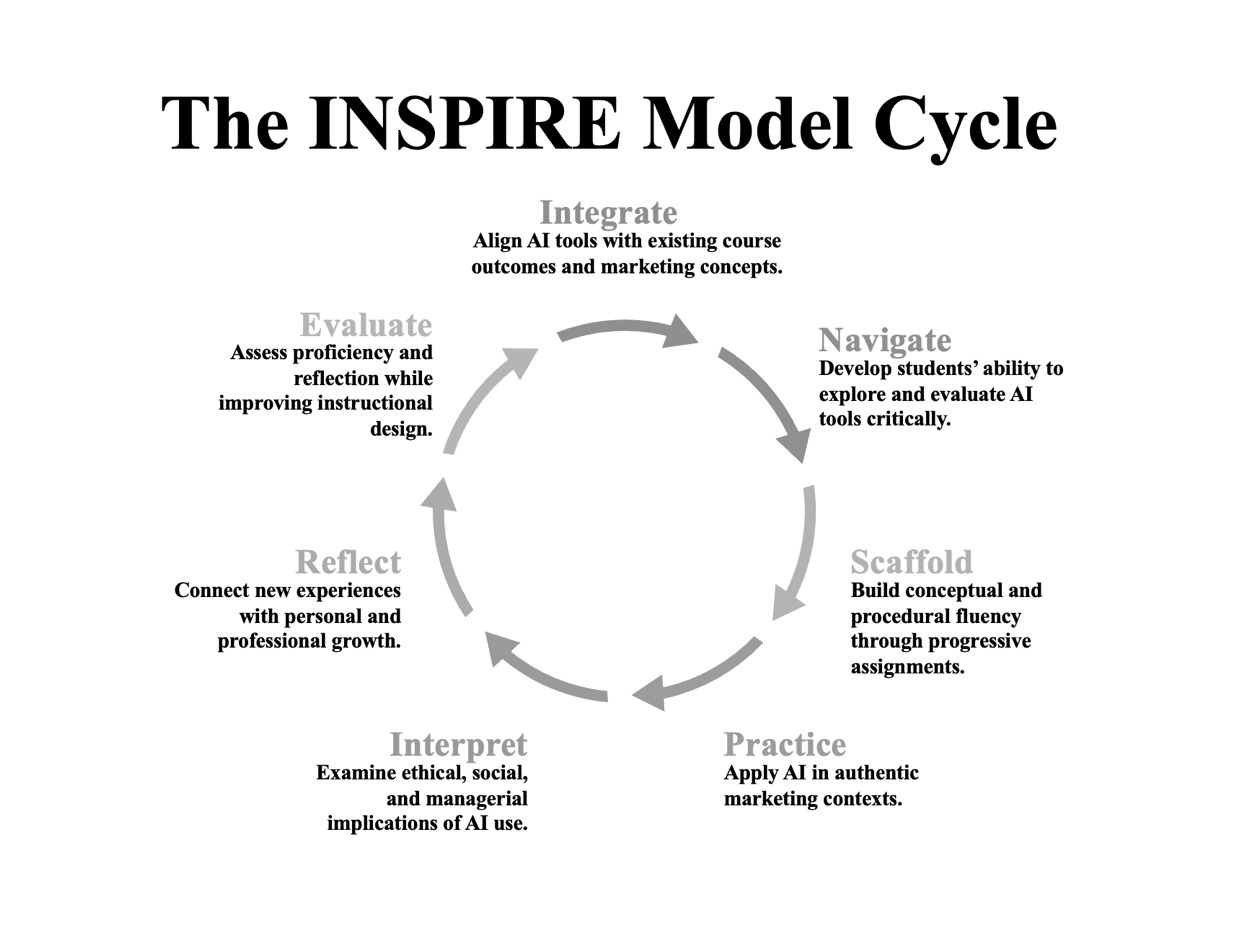
The INSPIRE stages aim to clarify expectations and reduce ambiguity across courses; whether this supports higher AI efficacy and skills transfer remains a question for empirical follow-up (Anglin et al., 2022; Biddle, 1986; Kumar et al., 2024).
Discussion and Future Research
Based on the data collected in this inquiry, including a coded thematic analysis finding that a larger share of students described Role Conflict or Role Ambiguity than described clarity (RQ1; see Results and Appendix F), the authors conclude that Role Conflict is possibly present among students and faculty alike. Related patterns appear in the MMA industry results. Reducing Role Conflict is a valuable organizational goal. The INSPIRE Model supports this objective within classroom settings, though broader application to adult-learning environments warrants further study. Although the present study draws on Role Theory rather than the Knowledge–Motivation–Organization (KMO) framework (Clark & Estes, 2008), the KMO framework offers a useful scaffold for organizing future work on AI integration as a performance problem. Read against KMO, the present study contributes primarily to the Knowledge dimension by surfacing uneven role-expectations knowledge across institutions. Future research could extend into the Motivation and Organization dimensions, including work on AI use in professional marketing contexts. As Pavone (2025) notes, progress depends on “clearly defining what constitutes legitimate AI-assisted work” (p. 18).
Future research should further specify Role Expectations Knowledge as a key predictor of AI efficacy. Recent work examining student readiness for AI-driven marketing practices finds similarly uneven confidence and awareness across institutional contexts, reinforcing the view that Role Clarity around AI use remains an unresolved curricular challenge for marketing education (Pettiette et al., 2026b). Integrating the Clark and Estes (2008) KMO framework offers a validated foundation for this exploration. The recent paper from Pavone (2025) looks at students’ motivations related to integrating GenAI into the learning process, but more work needs to be done in this area to understand Motivational factors more fully. Pavone concurs and proposes some motivational areas worthy of inquiry:
We examined two specific individual characteristics—self-esteem and academic anxiety. However, other traits may also play a significant role in shaping students’ motivation and satisfaction with AI tools. Future studies should explore additional psychological constructs to provide a more complete understanding (2025, p. 18)
The KMO framework (Clark & Estes, 2008) provides a robust, validated foundation for future approaches to this research. Organizational factors also merit attention, such as whether universities provide adequate tools (e.g., ChatGPT licenses) and leadership support. Consistent with the descriptive faculty data referenced earlier, 36% of marketing faculty respondents cited “limited support for change by leaders” as a barrier to AI integration. Reducing Role Conflict is therefore both a pedagogical and organizational performance goal. The broader integration of GenAI into higher education introduces institutional challenges for which established frameworks connecting knowledge, motivation, and organizational capacity may offer a useful starting point for further inquiry.
Limitations
This study has several limitations. First, student anxiety may have influenced responses, potentially impacting the accuracy and reliability of the findings. Additionally, the 2024–2025 sample is limited in both timing and size, which could affect the generalizability of the results. A further limitation is the cross-sectional design: data were collected through a single post-task survey, with no pre-task baseline. As a result, this study can characterize differences in AI efficacy and AI-related perceptions across students and institutions, but cannot directly evidence change in efficacy or perspective attributable to the AI assignments themselves. Future iterations of this work should incorporate matched pre/post measurement to test the developmental claims implicit in models like INSPIRE.
Another limitation relates to the differences in discussion around AI across universities. This disparity may have influenced the findings, particularly regarding which institutions appear more prepared to integrate AI into the workforce. While we were able to gather a few responses from faculty, a more robust analysis of how faculty across the field of marketing are embracing AI would be valuable. Given the exploratory nature of this research, findings should be interpreted as indicative rather than confirmatory, serving as a foundation for future hypothesis testing.
Conclusion
This study opens with industry data showing that AI use in the workplace is still taking shape rather than fully settled. Against that backdrop, both hypotheses were supported: AI Efficacy and Classroom AI Preparation each differed significantly across university locations, meaning students at some institutions perceive stronger classroom preparation for an AI-driven marketing future than students at others. These institutional differences are meaningful when interpreted against the industry benchmark data, which suggest that professional AI expectations are still emerging but increasingly task-specific. A supplementary faculty survey corroborates this pattern descriptively; among spontaneous open-ended responses relevant to AI-use expectations, students more often described ambiguity or inconsistent expectations than clear, unambiguous policy understanding. Together, these findings are consistent with the possibility that Role Conflict may emerge when campus expectations lag or diverge from workplace norms. We synthesize these insights into the INSPIRE Model, an educator-ready framework for bridging classroom preparation with workplace expectations.