
INTRODUCTION
Artificial intelligence (AI) has moved rapidly from peripheral experimentation to integration within marketing education (e.g., Grewal et al., 2025; Jayawardene et al., 2026). A major catalyst for this shift has been the rapid emergence of generative artificial intelligence systems such as ChatGPT and other large language models. Students increasingly use these tools to support tasks such as brainstorming ideas, drafting written work, summarizing information, and analyzing data. At the same time, instructors are beginning to experiment with generative AI for instructional design, feedback generation, and course development. As a result, AI technologies are no longer confined to specialized analytics platforms or adaptive learning systems but are becoming embedded in everyday teaching and learning practices within higher education (Kasneci et al., 2023). Generative and adaptive AI systems are now embedded in learning management platforms, assessment tools, analytics dashboards, and instructional support applications, shaping how marketing concepts are taught and how students engage with course material. For marketing educators in particular, these technologies offer compelling pedagogical opportunities, including real-time data analysis, simulation of market dynamics, personalized feedback, and exposure to tools increasingly used in professional practice. Prior research in marketing education highlights the discipline’s long-standing role as an early adopter of digital and analytics-driven instructional innovations, reflecting marketing’s close alignment with technological change in practice (Clark & Mayer, 2023; Harrigan et al., 2021; Peterson & Albaum, 2019).
Despite these pedagogical promises, AI adoption in marketing classrooms remains uneven and contested. Emerging research in education and information systems suggests that resistance to AI-enabled learning tools is not solely a function of technical skill or perceived utility but is often rooted in psychological responses to autonomy, opacity, and perceived loss of control (Beaudry & Pinsonneault, 2010; Ragu-Nathan et al., 2008; Selwyn, 2019). In the context of generative AI tools such as ChatGPT, students may feel uncertain about how to incorporate AI-generated outputs into academic work. At the same time, instructors may question the transparency and legitimacy of AI-supported feedback or evaluation processes (Kasneci et al., 2023). These concerns are further shaped by the institutional environment in which AI use occurs. Research on generative AI adoption in higher education shows that students interpret the legitimacy of tools such as ChatGPT through both peer cues and institutional cues, including professor expectations and university policy signals, and that institutional influence plays an important role in shaping intention to adopt generative AI as a learning tool (Pierce & Jiang, 2025). When policies are vague, inconsistent, or left to individual instructors, students may experience greater uncertainty about acceptable practices and greater apprehension regarding academic integrity risks (Pierce & Jiang, 2025). These reactions persist even as AI tools become increasingly familiar, indicating that AI Anxiety is not merely a novelty effect but a durable feature of AI-enabled learning environments (Holmes et al., 2019).
Technology acceptance research provides a useful foundation for understanding these dynamics, yet existing models exhibit important limitations when applied to AI-enabled learning environments. The rapid diffusion of generative AI tools such as ChatGPT in higher education raises new questions about how learners and instructors evaluate technologies whose outputs are probabilistic and whose internal processes are often opaque (Kasneci et al., 2023). Seminal frameworks such as the Technology Acceptance Model (TAM) and its extensions emphasize perceived usefulness and perceived ease of use as primary determinants of behavioral intention (Davis, 1989; Venkatesh et al., 2003). Within educational contexts, the General Extended Technology Acceptance Model of e-Learning (GETAMEL) further incorporates external variables, such as self-efficacy, enjoyment, and computer anxiety, to explain learners’ adoption of instructional technologies (Abdullah & Ward, 2016). While these models perform well in explaining the adoption of relatively transparent systems, most were developed in contexts where technologies functioned as passive tools rather than autonomous or generative agents.
Artificial intelligence introduces qualitatively different characteristics that challenge the assumptions underlying traditional acceptance models. Unlike earlier educational technologies, AI systems often operate with limited transparency, generate outputs probabilistically, and simulate human-like judgment, all of which complicate users’ ability to evaluate outcomes and assign responsibility (Castelo et al., 2019; Dietvorst et al., 2015). These characteristics are particularly salient in the context of generative AI tools such as ChatGPT, where users may struggle to understand how responses are generated or how outputs should be interpreted in academic contexts (Kasneci et al., 2023). Research on algorithm aversion and algorithm appreciation demonstrates that individuals frequently respond emotionally to automated systems, particularly when outcomes are unexpected or difficult to interpret. In learning environments, these emotional responses may influence not only whether AI tools are adopted but also how they are trusted and integrated into the learning process. Educational research on AI ethics and explainability further suggests that such affective responses are amplified when evaluative authority is delegated to opaque systems (Holmes et al., 2022).
To address this gap, this research introduces AI Anxiety as a multidimensional construct that captures cognitive, affective, and behavioral responses that arise when students and instructors interact with AI-enabled learning technologies in educational settings. Drawing on foundational research on computer anxiety, technostress, emotional responses to technology, and algorithm aversion, and extending those insights to today’s generative AI context, AI Anxiety is conceptualized as a psychological lens through which learners and educators interpret AI-enabled systems (Beaudry & Pinsonneault, 2010; Igbaria & Parasuraman, 1989; Ragu-Nathan et al., 2008). In the context of marketing education, these responses may emerge through both student-facing uses of generative AI tools such as ChatGPT and instructor-facing applications that influence instructional design, feedback, and assessment practices. By explicitly accounting for these interactions, the framework acknowledges that AI adoption in the classroom is shaped not only by functional evaluations of technology but also by emotional and psychological responses to intelligent systems. AI Anxiety is distinct from general discomfort with technology or labor-market displacement concerns; rather, it reflects apprehension arising from interactions with autonomous, opaque systems in learning contexts. The proposed conceptual model and propositions posit that AI Anxiety conditions the formation of perceptions of usefulness and ease of use, thereby reshaping the pathways through which these perceptions translate into behavioral intention.
This reconceptualization is particularly relevant to marketing education. As generative AI tools such as ChatGPT become increasingly integrated into marketing practice, educators face growing pressure to incorporate these technologies meaningfully into curricula (Grewal et al., 2025) while maintaining pedagogical integrity and student trust (Harrigan et al., 2021; Lamb et al., 2020). Marketing students are likely to encounter AI-enabled tools in analytics, content generation, and decision-support contexts throughout their professional careers. At the same time, instructors must determine how to incorporate AI into assignments, feedback processes, and classroom learning without undermining skill development or the legitimacy of assessments. Recent work in marketing education highlights the importance of aligning technological innovation with instructional transparency, assessment legitimacy, and learner confidence (Peterson & Albaum, 2019; Seif, 2026). Educators must therefore consider not only the functional capabilities of AI technologies but also the psychological responses they generate among learners and instructors. By extending GETAMEL to incorporate AI Anxiety, this research refines technology acceptance theory for AI-enabled learning environments and provides marketing educators with a framework for identifying and addressing psychological barriers to AI adoption in the classroom.
The institutional environment in which these technologies are introduced also plays an important role in shaping how students interpret AI-enabled learning tools. Recent research on generative AI adoption in higher education indicates that students often rely on institutional signals—including instructor expectations, course policies, and university guidance—to determine whether tools such as ChatGPT represent legitimate learning supports or potential academic integrity risks (Pierce & Jiang, 2025). When policies surrounding generative AI use are unclear or inconsistent across courses, students may experience greater uncertainty regarding appropriate practices. This ambiguity can increase apprehension toward AI-enabled systems and contribute to the development of AI Anxiety. Conversely, when educators provide clear guidance regarding acceptable uses of AI and demonstrate how such tools can be integrated responsibly into coursework, students may develop greater confidence in interacting with AI-supported learning technologies.
LITERATURE REVIEW
Technology Acceptance in Educational Contexts
Research on technology adoption in education has long been dominated by technology acceptance models that emphasize cognitive evaluations of usefulness and ease of use. The Technology Acceptance Model (TAM) established perceived usefulness and perceived ease of use as central determinants of behavioral intention, providing a parsimonious and widely validated explanation of why individuals adopt new technologies (Davis, 1989). Subsequent extensions, including the Unified Theory of Acceptance and Use of Technology (UTAUT), incorporated social influence and facilitating conditions to improve explanatory power across contexts (Venkatesh et al., 2003). In educational settings, these models have been widely applied to explain students’ and instructors’ adoption of learning management systems, e-Learning platforms, and digital instructional tools (Joo et al., 2018; Scherer et al., 2019; Teo, 2011).
Recognizing the unique characteristics of educational environments, scholars have adapted acceptance models to capture learning-specific dynamics better. The General Extended Technology Acceptance Model of e-Learning (GETAMEL) is among the most comprehensive efforts in this stream, integrating external variables such as self-efficacy, enjoyment, subjective norms, and computer anxiety into the traditional TAM framework (Abdullah & Ward, 2016). Large-scale reviews and synthesis work in information systems research further reinforce the continued relevance of acceptance models for understanding technology adoption across evolving digital contexts (Dwivedi et al., 2019). As a result, GETAMEL remains an appropriate and theoretically grounded foundation for examining technology acceptance in educational settings.
Psychological and Emotional Dimensions of Technology Use
Beyond cognitive evaluations of utility and usability, a substantial body of research highlights the role of emotional and psychological responses in shaping technology adoption. Early studies on computer anxiety demonstrated that apprehension and fear associated with technology use could negatively influence attitudes and intentions, even among technically capable users (Igbaria & Parasuraman, 1989). This work builds on foundational psychological theory, distinguishing situational and dispositional anxiety responses that influence perception and behavior (Spielberger, 1983). Subsequent research expanded this perspective by introducing technostress, which captures stress responses arising from complexity, overload, and uncertainty associated with technology use (Ragu-Nathan et al., 2008).
More recent work in information systems emphasizes that emotional responses are not peripheral to adoption decisions but are integral to how individuals interpret and engage with technology. Beaudry and Pinsonneault (2010) demonstrate that users experience a range of emotional reactions—such as anxiety, frustration, and threat—when encountering new systems, and that these emotions shape coping behaviors and system use over time. Related research shows that emotional responses influence how users revise beliefs and behaviors in response to system outcomes, even when functional performance is high (Sun, 2012). In educational contexts, such affective responses may therefore shape trust in feedback, perceptions of fairness, and sustained engagement with instructional technologies (Holmes et al., 2022; Selwyn, 2019).
AI-Specific Challenges in Marketing Education
Artificial intelligence introduces characteristics that fundamentally alter how learners and educators experience educational technologies. Unlike earlier systems, AI-enabled tools often operate with limited transparency, produce probabilistic outputs, and simulate human-like judgment, making it difficult for users to understand how decisions are made or to reliably predict outcomes (Dietvorst et al., 2015; Dwivedi et al., 2021). Research on algorithm aversion demonstrates that individuals often react negatively to automated systems when errors occur or when decision logic is opaque, even when those systems outperform human judgment (Castelo et al., 2019; Dietvorst et al., 2018).
In educational settings, these dynamics are particularly salient. Students interacting with AI graders, chatbots, or adaptive learning systems may struggle to interpret feedback, question the legitimacy of automated evaluations, or feel a diminished sense of agency over their learning outcomes. Educators, in turn, may hesitate to rely on systems whose outputs are difficult to explain pedagogically or defend to students. Importantly, such responses persist even as AI tools become more familiar, indicating that emotional reactions to autonomy and opacity are not merely transitional effects associated with early adoption (Selwyn, 2019).
Marketing education provides a distinctive context for examining these challenges. As a discipline closely tied to analytics, automation, and digital strategy, marketing education has been at the forefront of integrating AI-enabled tools into curricula (Harrigan et al., 2021). Conceptual work on AI ecosystems and intelligent systems further suggests that AI adoption involves not only functional evaluation but also broader interpretive and ethical considerations that shape user acceptance (Huang & Rust, 2021; Onel et al., 2025). While these tools enhance realism and career relevance, they also introduce psychological complexities that existing acceptance frameworks do not fully capture.
Prior research highlights a critical gap at the intersection of technology acceptance, emotional response, and AI-enabled learning. Wu and Li (2025) conducted a review of AI Anxiety in education research (n=32) that spanned both K-12 and higher education. They found AI Anxiety to be a negative emotional response that impacts psychological and emotional dimensions, including self-efficacy, behavioral intentions, motivation, and attitudes toward AI. While GETAMEL provides a robust foundation for studying educational technology adoption, it does not explicitly account for the distinctive anxiety elicited by autonomous and opaque AI systems. Addressing this gap requires reconceptualizing AI Anxiety as a central psychological mechanism shaping how learners and educators evaluate, trust, and ultimately adopt AI in marketing education.
Contextual and Individual Influences on AI Adoption in Education
Technology adoption in educational environments is shaped not only by perceptions of usefulness and ease of use but also by contextual and individual factors that influence how technologies are interpreted and integrated into learning environments. Within technology acceptance research, contextual factors such as institutional support, social norms, and instructor behavior have long been recognized as important influences on technology adoption (Dwivedi et al., 2019; Venkatesh et al., 2003). In higher education settings, these contextual influences may include institutional policies regarding artificial intelligence, expectations surrounding academic integrity, and the extent to which instructors model or encourage the use of emerging technologies in coursework.
Recent research on generative AI adoption in higher education further highlights the importance of institutional signals in shaping how students interpret AI technologies such as ChatGPT. Students often learn about generative AI tools through peers, but institutional cues—including faculty expectations, course policies, and university guidance—play an important role in determining whether these tools are perceived as legitimate learning resources or as sources of academic risk (Pierce & Jiang, 2025). When institutional expectations are unclear or inconsistent across courses, students may experience uncertainty regarding appropriate use, which can amplify apprehension toward AI-enabled learning technologies. Conversely, when instructors openly demonstrate responsible uses of generative AI or provide clear guidance regarding acceptable practices, students may develop greater confidence in interacting with these systems (Pierce & Jiang, 2025).
Individual characteristics also influence how learners respond to AI-enabled learning technologies. Prior research on technology adoption highlights the importance of factors such as self-efficacy, prior technology experience, and generational cohort in shaping perceptions of technology and behavioral intention (Abdullah & Ward, 2016; Scherer et al., 2019). In the context of AI-enabled learning, students with greater familiarity or confidence in using digital tools may feel more comfortable experimenting with generative AI systems, while others may experience heightened uncertainty when interacting with technologies whose outputs are difficult to interpret. Similarly, instructors’ prior exposure to AI technologies and their perceptions of pedagogical value may influence how these tools are introduced and discussed within the classroom.
Together, these contextual and individual influences shape the environment in which AI-enabled technologies are encountered in marketing education. They do not replace the core mechanisms of technology acceptance models but instead influence how learners and educators interpret and respond to intelligent systems. Recognizing these influences provides important context for understanding how AI Anxiety emerges and how it may shape perceptions of usefulness, ease of use, and behavioral intention within AI-enabled learning environments.
CONCEPTUAL FRAMEWORK DEVELOPMENT
Defining AI Anxiety in Marketing Education
As AI tools become part of everyday teaching and learning, students and instructors are no longer interacting only with passive software. They engage with systems that generate feedback, make recommendations, and sometimes evaluate their own work. Existing research on technology-related discomfort—particularly computer anxiety and technostress—offers a useful starting point, but it does not fully account for the reactions that arise when users cannot easily see how a system reaches its conclusions (Igbaria & Parasuraman, 1989; Ragu-Nathan et al., 2008). Furthermore, algorithm aversion is typically examined in performance-comparison contexts, whereas AI Anxiety in educational settings centers on learners’ perceptions of the legitimacy and trustworthiness of evaluative authority.
Computer anxiety has been defined as “the tendency of an individual to be uneasy, apprehensive, or fearful about the current or future use of computers in general” (Igbaria & Parasuraman, 1989, p. 375). The emphasis in this stream of research is typically on skill, complexity, and fear of making mistakes. Technostress similarly focuses on strain caused by overload, constant change, and increasing system demands (Ragu-Nathan et al., 2008). In both cases, AI Anxiety stems from the use of technology that requires effort, competence, and adaptation.
AI systems raise somewhat different concerns. Research on algorithm aversion shows that people often react negatively when automated systems make errors or when their decision logic is unclear (Castelo et al., 2019; Dietvorst et al., 2015). The discomfort in these situations is not only about difficulty or workload. It often reflects uncertainty about fairness, accountability, and the trustworthiness of the system’s judgments. When the reasoning behind an output is hard to explain, users may feel less confident in relying on it.
Based on their review, Wu and Li (2025) describe AI anxiety as an affective response that arises in contexts where AI systems operate with limited transparency and users perceive reduced control. Their findings show consistent links between AI anxiety and lower self-efficacy, weaker engagement, and reduced intention to use AI-supported tools. These patterns suggest that AI Anxiety plays a meaningful role in shaping how AI is received in educational settings.
Drawing on this work, the present study uses the term AI Anxiety to refer to a set of cognitive, emotional, and behavioral reactions that occur when learners or instructors interact with AI systems in the classroom. Cognitively, individuals may question how outputs are produced or evaluated. Emotionally, they may experience unease or reduced trust. Behaviorally, they may hesitate, avoid certain features, or alter their engagement with AI-enabled tools.
This definition is consistent with Wu and Li’s (2025) findings. However, it places the construct within a technology acceptance framework to clarify how these reactions influence beliefs about usefulness and ease of use. The emphasis here is on classroom experiences rather than broader fears about automation or job loss. Framed in this way, AI Anxiety captures a specific form of discomfort tied to interacting with intelligent systems in educational contexts. These reactions may also be shaped by the institutional environment in which AI tools are introduced. When policies, course guidelines, or faculty expectations regarding the use of generative AI are unclear or inconsistent, students may experience greater uncertainty about appropriate practices, which can amplify apprehension toward AI-enabled learning technologies (Pierce & Jiang, 2025).
Integrating AI Anxiety into GETAMEL
The General Extended Technology Acceptance Model of e-Learning (GETAMEL) provides a robust foundation for examining technology adoption in educational settings by extending traditional acceptance models to incorporate external variables relevant to learning environments (Abdullah & Ward, 2016). By integrating factors such as self-efficacy, enjoyment, subjective norms, and general anxiety, GETAMEL moves beyond purely cognitive evaluations of usefulness and ease of use. However, the model was developed primarily in the context of educational technologies that function as supportive tools rather than autonomous decision-making agents.
AI-enabled learning technologies challenge this assumption by introducing characteristics that shape how users interpret and evaluate system outputs. When learners or educators encounter AI systems, perceptions of usefulness and ease of use may be filtered through psychological responses to opacity, autonomy, and perceived loss of control. Research in information systems suggests that emotional responses to technology influence not only attitudes but also how individuals cognitively process information about system performance and reliability (Beaudry & Pinsonneault, 2010). In AI contexts, these emotional responses may therefore intervene in the formation of key acceptance beliefs rather than operating as peripheral influences.
Integrating AI Anxiety into GETAMEL involves reconceptualizing anxiety as a central psychological mechanism that conditions the acceptance process. Rather than treating anxiety as a background variable, this framework positions AI Anxiety as shaping how individuals interpret a system’s usefulness and ease of use before these perceptions translate into behavioral intention. For example, learners experiencing heightened AI Anxiety may discount the usefulness of an AI tool despite recognizing its functional capabilities or may perceive a system as difficult to use because its decision logic is unclear, rather than because of interface complexity. In this way, AI Anxiety alters the evaluative pathways emphasized in traditional acceptance models.
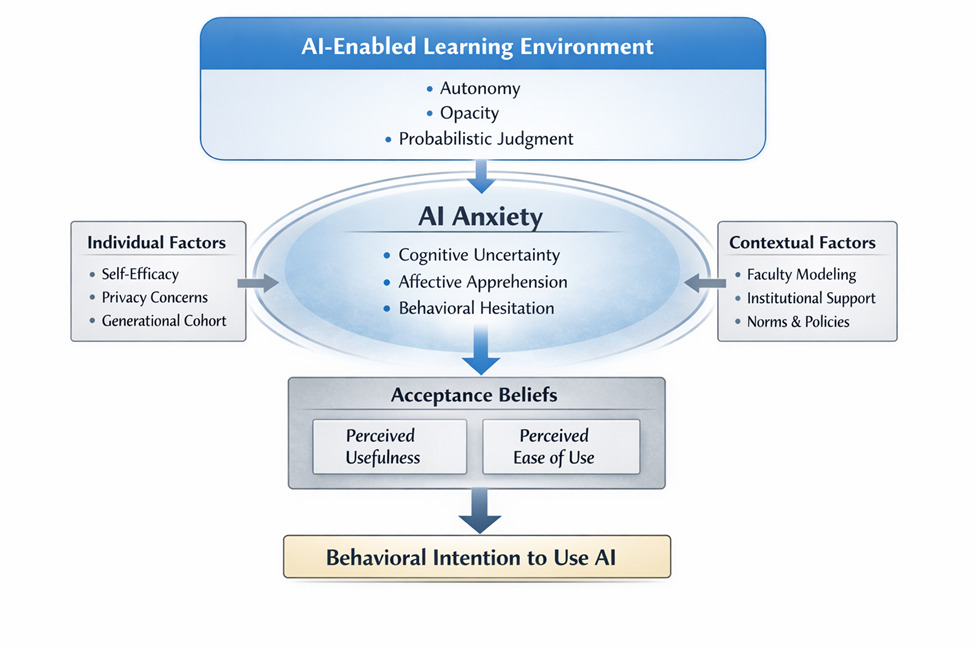
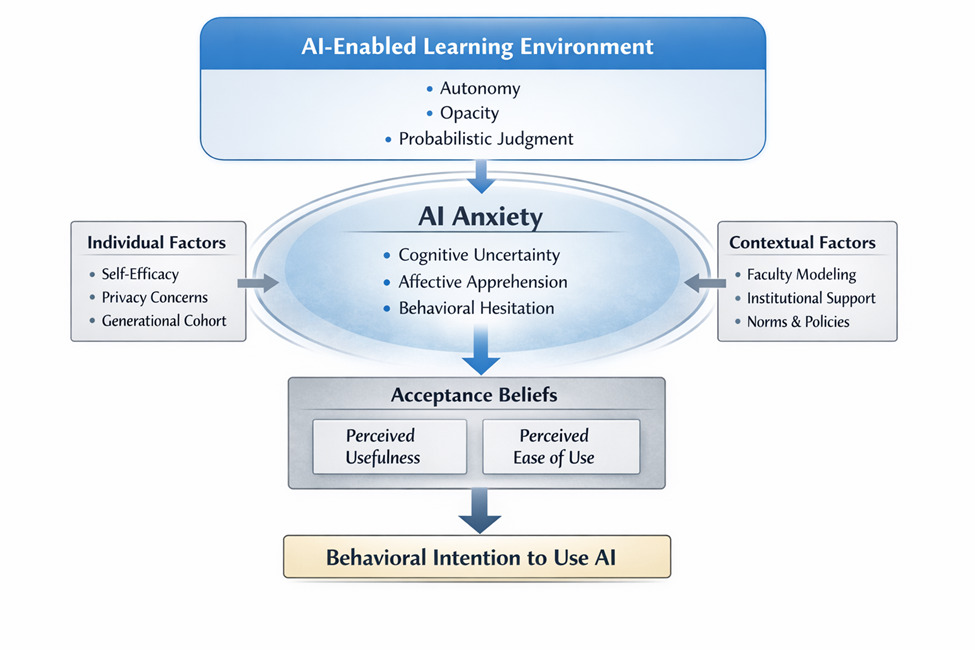
This integration does not replace GETAMEL’s core structure but refines it to account for the distinctive features of AI-enabled learning technologies. By explicitly incorporating AI Anxiety, the framework acknowledges that both rational assessments and psychological responses to autonomy and opacity shape adoption decisions in AI contexts. This refinement is particularly relevant for marketing education, where AI tools increasingly simulate real-world decision-making and evaluative processes. The resulting conceptual framework provides a theoretically grounded basis for examining how AI Anxiety influences acceptance and sets the stage for articulating testable relationships among acceptance constructs in subsequent sections. Figure 1 presents the authors’ AI Anxiety-GETAMEL framework, illustrating how AI Anxiety functions as a psychological conditioning mechanism linking AI system characteristics to technology acceptance beliefs and behavioral intention in marketing education. Consistent with Wu and Li’s (2025) findings that AI anxiety influences behavioral intention and learning engagement, the following propositions specify how AI Anxiety conditions the formation of perceived usefulness and perceived ease of use within GETAMEL.
Propositions
Building on the conceptual framework (Figure 1) developed in the previous section, this research advances a set of propositions that articulate how AI Anxiety shapes technology acceptance in marketing education. These propositions extend the General Extended Technology Acceptance Model of e-Learning (GETAMEL) by specifying the psychological mechanisms through which AI-specific characteristics influence perceptions and behavioral intention. Consistent with prior acceptance research, the framework retains perceived usefulness and perceived ease of use as central evaluative constructs, while recognizing that their formation and influence may be conditioned by affective responses unique to AI-enabled systems.
AI Anxiety and Perceived Usefulness
Perceived usefulness reflects the extent to which an individual believes that a technology enhances learning performance (Davis, 1989). In educational settings, usefulness judgments depend not only on functional capability but also on confidence in system outputs and their legitimacy. Wu and Li (2025) report consistent evidence that AI anxiety is negatively associated with behavioral intention and learning engagement, often through its effects on self-efficacy and motivational processes. These findings suggest that AI Anxiety shapes how individuals interpret the value of AI-enabled tools, even when those tools demonstrate objective effectiveness. Research on algorithm aversion similarly shows that users may discount the value of automated systems when they experience discomfort with autonomy or opacity (Castelo et al., 2019; Dietvorst et al., 2015).
Proposition 1:
In marketing education, heightened AI Anxiety reduces perceived usefulness of AI-enabled learning technologies by increasing concerns about the credibility and appropriateness of AI-supported learning activities.
AI Anxiety and Perceived Ease of Use
Perceived ease of use refers to the extent to which a technology is perceived as requiring minimal effort (Davis, 1989). Traditional interpretations emphasize the simplicity of the interface and the technical complexity. However, Wu and Li (2025) note that AI anxiety is closely tied to perceptions of control and confidence when interacting with intelligent systems. When users feel uncertain about how an AI system arrives at its outputs, the interaction may be perceived as cognitively demanding, even if the interface itself is intuitive. Emotional responses to opacity and unpredictability can increase vigilance and perceived effort, thereby influencing ease-of-use evaluations (Beaudry & Pinsonneault, 2010).
Proposition 2:
In marketing education, heightened AI Anxiety reduces perceived ease of use of AI-enabled learning technologies because uncertainty about system logic creates psychological strain during interaction.
Perceived Usefulness, Perceived Ease of Use, and Behavioral Intention
Consistent with established acceptance models, perceived usefulness and perceived ease of use are expected to exert direct positive effects on behavioral intention to adopt or continue using educational technologies (Davis, 1989; Venkatesh et al., 2003). In GETAMEL, these relationships represent the core evaluative pathways through which external variables ultimately influence adoption decisions (Abdullah & Ward, 2016). In AI-enabled learning environments, these pathways remain central but may be conditioned by psychological responses to system characteristics.
Behavioral intention reflects an individual’s motivational readiness to engage with a technology and is shaped by the cumulative evaluation of its anticipated benefits and usability. When AI Anxiety alters how usefulness and ease of use are perceived, it indirectly influences intention by reshaping these foundational beliefs. Thus, while AI Anxiety does not eliminate the role of perceived usefulness and perceived ease of use, it intervenes in the acceptance process by influencing how these perceptions are formed and weighted.
Proposition 3:
Perceived usefulness of AI-enabled learning technologies positively influences behavioral intention in marketing education.
Proposition 4:
Perceived ease of use of AI-enabled learning technologies positively influences behavioral intention in marketing education.
The Conditioning Role of AI Anxiety in the Acceptance Process
Integrating the preceding propositions, the framework positions AI Anxiety as a psychological mechanism that conditions the relationship between evaluative beliefs and behavioral intention. Rather than functioning solely as a background factor, AI Anxiety shapes how learners and educators interpret AI-enabled systems at multiple points in the acceptance process. When AI Anxiety is elevated, perceptions of usefulness and ease of use may be attenuated, and these beliefs may be formed differently and weighted differently in the decision process. Conversely, when AI Anxiety is low, individuals may be more receptive to evaluating AI systems based on functional performance and usability.
Proposition 5:
AI Anxiety functions as a conditioning psychological mechanism in the acceptance process by shaping how beliefs about usefulness and ease of use are formed and weighted, thereby altering the strength and nature of their relationships with behavioral intention toward AI-enabled learning technologies in marketing education.
This conditioning role aligns with prior research demonstrating that emotional responses influence cognitive appraisals and decision-making processes in technology use (Beaudry & Pinsonneault, 2010). In the context of AI-enabled marketing education, explicitly incorporating AI Anxiety into GETAMEL allows the model to account for psychological dynamics that are not fully captured by traditional acceptance variables. The resulting framework provides a coherent theoretical basis for examining AI adoption and establishes a foundation for future empirical testing.
DISCUSSION
This research advances technology acceptance scholarship by developing the authors’ AI Anxiety-GETAMEL framework for marketing education. The framework extends the General Extended Technology Acceptance Model of e-Learning (GETAMEL) to a context in which educational technologies are no longer merely supportive delivery tools, but increasingly operate as intelligent systems that generate content, shape feedback, and influence evaluative processes. Traditional acceptance models have provided strong explanatory value in studies of instructional technologies, yet they were developed largely around systems whose functions were comparatively transparent and whose outputs were more readily interpretable by users (Abdullah & Ward, 2016; Davis, 1989; Venkatesh et al., 2003). When those foundational insights are applied to today’s AI-enabled learning environments, an important limitation becomes visible: learners and instructors are not responding only to usability and functionality, but also to the psychological implications of opacity, autonomy, and probabilistic output generation. Drawing on prior work on technology-related emotions and acceptance processes, this study argues that AI Anxiety helps explain how these distinctive features of AI reshape the formation of core acceptance beliefs in marketing education (Beaudry & Pinsonneault, 2010).
Theoretical Implications
This research makes several theoretical contributions. First, it refines GETAMEL for a contemporary educational environment in which AI-enabled systems increasingly mediate learning, feedback, and assessment. While TAM-based models remain useful for understanding educational technology adoption, their traditional emphasis on perceived usefulness and perceived ease of use does not fully capture how users respond when technologies appear agentic, opaque, or difficult to interrogate. Prior research on technology acceptance established the importance of cognitive evaluations in shaping behavioral intention (Davis, 1989; Teo, 2011), and GETAMEL extended this logic by incorporating external variables such as self-efficacy, enjoyment, subjective norms, and anxiety in e-Learning settings (Abdullah & Ward, 2016). The present study builds on that tradition by arguing that, in AI-enabled learning contexts, anxiety should not be treated merely as a background discomfort variable. Instead, AI Anxiety operates as a conditioning psychological mechanism that shapes how users interpret usefulness and ease of use in the first place.
Second, this study helps clarify construct boundaries by distinguishing AI Anxiety from adjacent constructs such as computer anxiety and technostress. Foundational studies on computer anxiety and technology-related stress show that users may feel apprehension when confronting unfamiliar or demanding systems (Igbaria & Parasuraman, 1989; Ragu-Nathan et al., 2008). Those insights remain valuable, but when extended to the current AI context, they do not fully capture the distinctive unease associated with systems that simulate judgment, generate probabilistic outputs, and often obscure the logic behind those outputs. Likewise, prior work on emotional responses to technology use demonstrates that users’ affective reactions can shape coping patterns, interpretation, and continued system use (Beaudry & Pinsonneault, 2010). The present framework applies these broader insights to AI-enabled learning technologies and argues that AI Anxiety reflects a more specific form of discomfort rooted in concerns about interpretability, legitimacy, accountability, and control. In doing so, the framework offers greater conceptual precision for future empirical work.
Third, this research contributes to emerging scholarship on human responses to algorithmic and AI-supported decision systems. Studies of algorithm aversion and algorithm appreciation suggest that people do not evaluate automated systems solely on objective performance; rather, they also respond to whether those systems feel understandable, trustworthy, and appropriate for the task at hand (Castelo et al., 2019; Dietvorst et al., 2015; Logg et al., 2019). The present study extends those insights into the marketing education context by proposing that these reactions are especially consequential when AI is embedded in learning environments, where students and instructors must interpret not only output quality but also the fairness, credibility, and pedagogical legitimacy of the system’s role. AI Anxiety therefore provides a theoretically parsimonious explanation for why acceptance dynamics that perform well in earlier e-Learning research may not transfer cleanly into AI-enabled educational settings.
Finally, this research advances the emerging literature on AI Anxiety in education by providing a mechanism-based explanation for previously observed relationships. Wu and Li (2025) synthesize evidence showing that AI anxiety is associated with outcomes such as lower self-efficacy, reduced motivation, and weaker behavioral intention. The present study builds on that foundation by specifying how AI Anxiety exerts influence within a technology acceptance framework. Rather than treating AI anxiety as a broad correlate of resistance, the authors’ AI Anxiety-GETAMEL framework positions it as a conditioning mechanism that alters the way core acceptance beliefs are formed and weighted. In this sense, the framework moves the literature from description toward explanation.
Implications for Marketing Education
The framework also offers important implications for marketing education. Marketing programs have long emphasized technological relevance, analytics, and the practical application of emerging tools in professional settings (Harrigan et al., 2021; Parker et al., 2024). More recently, scholarship has highlighted the growing importance of integrating AI into marketing curricula as the technology becomes increasingly embedded in practice (Grewal et al., 2025; Seif, 2026). At the same time, integration alone does not guarantee acceptance. Students may recognize that AI tools are career-relevant and functionally useful while still feeling uneasy about relying on them in learning environments. Instructors may likewise acknowledge the pedagogical potential of AI-assisted systems while hesitating to incorporate them into course design or assessment practices if they perceive risks to transparency, legitimacy, or student trust.
The authors’ AI Anxiety-GETAMEL framework helps explain why this tension persists. If learners interpret AI-supported tools through a lens of uncertainty, perceived usefulness may be discounted even when the technology performs well. Similarly, a tool may appear easy to operate at the interface level while still being experienced as psychologically effortful because its logic is unclear or its outputs feel difficult to evaluate. This insight is especially important in marketing education, where AI tools increasingly intersect with writing, analytics, strategic thinking, content creation, and decision support. In these environments, adoption is not simply a matter of access or technical competency. It is also shaped by whether learners and instructors view AI as a legitimate, understandable, and trustworthy participant in the educational process.
This perspective also helps interpret emerging empirical findings in marketing education. Research shows that marketing students’ intentions to adopt ChatGPT are influenced by factors such as performance expectancy, effort expectancy, social influence, habit, and system flexibility (Gulati et al., 2024). Those findings reinforce the continued relevance of acceptance variables, but they do not fully explain why adoption may remain uneven even when perceived value is high. The present framework suggests that AI Anxiety may be one reason for that inconsistency. When students are uncertain about whether AI outputs are reliable, whether their use is pedagogically appropriate, or whether institutional expectations are clear, those concerns may weaken the positive effects of perceived usefulness and ease of use on behavioral intention.
The framework further suggests that AI Anxiety should be treated as a pedagogical issue rather than merely a technical one. Institutional and classroom conditions likely shape whether AI-enabled systems are experienced as empowering supports or as ambiguous risks. Research on generative AI adoption in higher education indicates that institutional signals, faculty expectations, and policy clarity influence how students interpret the legitimacy of AI tools and the risks associated with using them (Pierce & Jiang, 2025). In practical terms, this means that marketing educators should not assume that AI adoption will occur naturally once tools are introduced into the curriculum. Students may need clearer guidance regarding acceptable use, more explicit framing of how AI supports learning objectives, and greater transparency around when and why AI is being used in feedback, assessment, or course activities. Such conditions may reduce uncertainty and help prevent AI Anxiety from undermining acceptance.
The practical importance of these issues is reinforced by the broader business environment into which marketing students will graduate. Industry adoption of AI has expanded rapidly, particularly since the widespread emergence of generative AI. McKinsey’s global surveys indicate that organizational AI use has risen sharply in recent years, with generative AI accelerating the pace and visibility of adoption across business functions (McKinsey & Company, 2025). From a curricular standpoint, this means marketing educators face dual pressures: they must prepare students to work effectively with AI-enabled tools, while also helping them navigate the cognitive and emotional uncertainty such tools may create. The framework developed here suggests that successful integration requires more than exposure. It requires attention to trust, legitimacy, explainability, and the learner experience surrounding AI-enabled systems.
More broadly, the framework underscores that uneven AI adoption in marketing education should not be interpreted automatically as resistance to innovation. In many cases, it may instead reflect a rational psychological response to systems that appear difficult to interrogate, difficult to challenge, or difficult to situate within established norms of fairness and academic integrity. Recognizing this point allows marketing educators and institutions to take a more human-centered approach to AI integration. Rather than asking only whether AI tools are available or efficient, educators should also ask whether students understand the role those tools are playing, whether expectations are consistent across courses, and whether the learning environment supports confident and informed engagement with intelligent systems.
In sum, this research responds to an important gap in both technology acceptance theory and marketing education scholarship. By developing the authors’ AI Anxiety-GETAMEL framework, the study shows that AI adoption in educational settings is shaped not only by perceptions of usefulness and ease of use, but also by a distinct psychological mechanism tied to how users experience autonomy, opacity, and uncertainty in intelligent systems. The framework therefore offers a stronger theoretical basis for understanding acceptance in AI-enabled learning environments and provides marketing education scholars with a conceptually grounded lens for examining why adoption may remain uneven even as AI becomes more embedded in both higher education and professional practice.
LIMITATIONS AND FUTURE RESEARCH
As a conceptual study, this research is subject to several limitations that should be acknowledged. First, the framework advances theoretically grounded propositions but does not provide empirical testing of the proposed relationships. While this approach is appropriate for theory development, the absence of empirical validation limits the ability to assess effect sizes, causal directionality, or contextual variation.
The conceptual framework developed in this research provides a foundation for future empirical research examining AI adoption in marketing education and related disciplines. Scholars may test the proposed relationships across different AI applications, learner populations, and instructional contexts to assess the robustness and boundary conditions of the framework (Scherer et al., 2019). Longitudinal research designs may be particularly valuable for examining how AI Anxiety evolves over time as familiarity increases and institutional norms stabilize. While the framework distinguishes AI Anxiety from broader technology discomfort and labor-market displacement concerns, it does not explicitly model all potential contextual moderators.
Future research may also explore how institutional policies and instructional practices shape the development of AI Anxiety in educational environments. As universities continue to develop guidelines governing the use of generative AI tools such as ChatGPT, students may encounter different policy environments across institutions and courses. Research on generative AI adoption suggests that institutional signals—including faculty expectations and university policy guidance—play an important role in shaping how students interpret the legitimacy and risks associated with these technologies (Pierce & Jiang, 2025). Empirical studies could therefore examine how differences in policy clarity, instructor modeling, and institutional support influence students’ perceptions of AI-enabled learning technologies and the extent to which AI Anxiety affects technology acceptance. Future research should empirically examine the role of AI Anxiety within marketing education using experimental, survey-based, or mixed-methods designs to evaluate the robustness of the proposed relationships.
Marketing programs often emphasize analytics, automation, and technology-enabled decision-making, potentially heightening both exposure to and reliance on AI-enabled tools. As a result, the salience and expression of AI Anxiety may differ in disciplines with less frequent interaction with intelligent systems. Beyond marketing education, the framework may be adapted to other professional disciplines where AI systems increasingly mediate evaluation, feedback, and decision-making. By articulating a theoretically grounded mechanism linking emotional responses to acceptance outcomes, this work opens avenues for interdisciplinary research on AI-enabled learning and instructional design, as well as research on the integration of AI-enabled tools within marketing education. Collectively, these contributions advance understanding of how psychological factors shape the adoption of intelligent technologies in educational environments and support more nuanced, human-centered approaches to AI integration.
Funding
The authors received no financial support for the research, authorship, or publication of this article.
Conflict of Interest
The authors declare no potential conflicts of interest with respect to the research, authorship, or publication of this article.
Ethical Approval
This study is conceptual in nature and does not involve human participants, human data, or animals. As such, ethical approval was not required.
Informed Consent
Not applicable. This study does not involve human subjects.
Data Availability
No data were generated or analyzed for this study.
Use of Artificial Intelligence
Grammarly was used in a limited capacity to support language refinement and organizational clarity. All conceptual development, theoretical framing, interpretation, and final content decisions were made by the authors, who take full responsibility for the integrity and originality of the work.